Blog

Solving the Difficulty of Large Part Machining: NextasTech Side‑Inlet Zero‑Point Clamping System Guide

Discover how the NextasTech Side-Inlet Zero-Point Clamping System solves large-part machining challenges with <0.003 mm repeatability, >40,000 N clamping force, and up to 90% faster changeovers.

Published on August 26, 20254 min read
Table of contents

Need help with workholding?

Tell us your machine type, material, and tolerance target — we’ll recommend the best setup.

Request a Technical Consultation →

The Challenges of Large Part Machining

Precision Maintenance

Large parts often carry tight tolerance requirements. Vibration, thermal growth, and multiple set‑ups can stack deviations that push you out of spec. Aerospace structures are a prime example—tiny errors can escalate into assembly misalignment and costly rework.

Workpiece Size and Weight Management

Traditional clamping may not provide the support that multi‑meter, high‑mass components require. Insufficient rigidity causes micro‑movement under load, degrading surface finish and dimensional accuracy while also increasing safety risks on the shop floor.

Efficiency Optimization

Long cycle times are common for large components. If every changeover requires manual alignment and probing, non‑cut time balloons—raising cost per part and choking throughput.

How the Side‑Inlet Zero‑Point System Solves It

Unparalleled Precision

The system offers repeatable positioning accuracy of < 0.003 mm. The side‑inlet design stabilizes the clamping interface and isolates external disturbances so datums remain consistent over long machining sequences.

Robust Workpiece Support

With a clamping force of > 40,000 N, the interface locks large and heavy workpieces with confidence. That stability protects surface integrity and maintains tolerance in demanding applications such as energy turbines and aerospace structures.

Enhanced Efficiency

A standardized zero‑point interface enables rapid changeovers—up to 90% faster vs. conventional methods. Operators swap pallets or parts quickly and safely, compressing set‑up time and lifting spindle utilization.

Application Scenarios

Aerospace

Wing spars, fuselage frames, and structural panels benefit from high repeatability and high clamping force across large spans—exactly where the system delivers measurable gains.

Energy

In wind and conventional power, hub components, housings, and turbine parts demand rigid fixturing and repeatable datums to ensure stable, high‑quality machining.

Heavy Machinery

Construction and mining components—boxes, frames, carriages—require scalable, robust clamping that adapts to different sizes while preserving accuracy.

Technical Specifications & Features

  • Repeatable positioning accuracy: < 0.003 mm
  • Clamping force: > 40,000 N
  • Unlock pressure: 0.5?.8 MPa
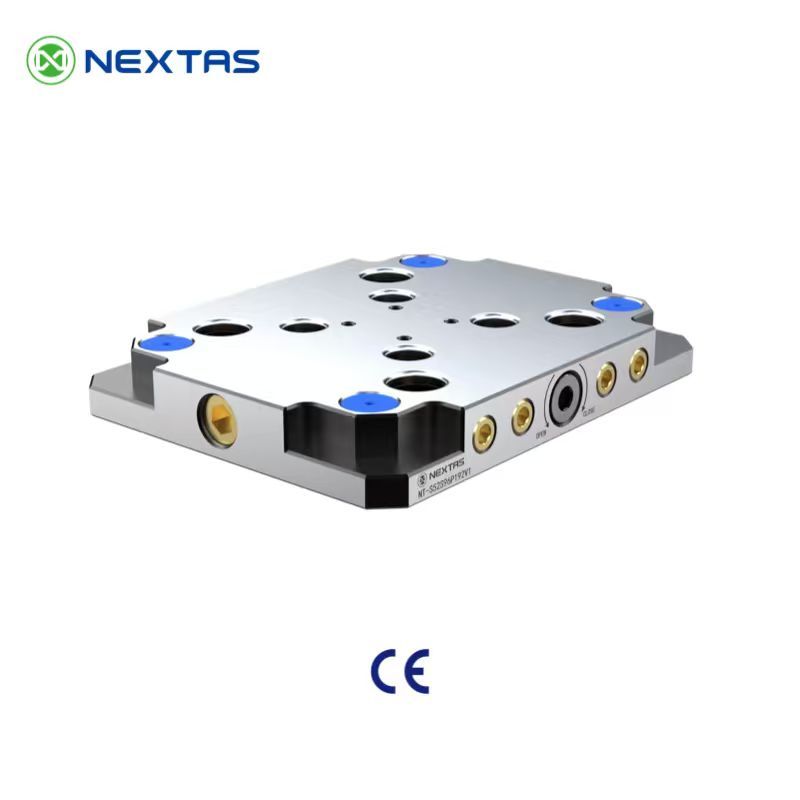
  • Side‑Inlet Design for better accessibility and stable clamping on large setups.
  • Hardened Stainless Steel construction for durability in harsh environments.
  • Self‑Cleaning interface that sheds chips and coolant carry‑over to maintain performance.

Installation & Maintenance

The modular architecture integrates cleanly with existing fixtures and pallets. We recommend installation by trained technicians to ensure full performance from day one. For maintenance, inspect clamping surfaces periodically, verify pneumatic circuits for leaks, and keep the interface clean to preserve precision and service life.


The NextasTech Side‑Inlet Zero‑Point Clamping System is purpose‑built for large part machining. It pairs sub?.003 mm repeatability with >40 kN clamping and rapid changeovers to elevate quality, safety, and throughput across aerospace, energy, and heavy machinery applications.

Comparison, Selection & Cost Guide (Quick Tables)

Use the quick tables below to choose the right workholding setup for jobs like “Solving the Difficulty of Large Part Machining: NextasTech Side‑Inlet Zero‑Point Clamping System Guide”. We focus on changeover time, repeatability, automation readiness, and total cost—so you can make a confident choice fast.

Quick comparison: common workholding options

OptionBest forStrengthsWatch-outsTypical changeover
Zero-point system / zero-point clamping plateFrequent part changes, multi-part families, modular setupsFast repeatable locating, scalable, automation-readyNeeds clean interfaces; plan for chip control30–120 sec
Zero Point Clamping Plate + pallet standardsHigh repeatability + fast swaps on fixtures/palletsStable datum, scalable modularity, automation‑readyCleanliness + stud compatibility; plan chip control20–60 sec
Pneumatic viseHigh mix + unattended runs where cycle time mattersStable clamping force, easy automation, consistent loadingAir quality + pressure stability; safety interlocks1–3 min
Self-centering viseSymmetric parts, 5-axis access, quick centeringCenters fast, reduces setup errors, good for 5-axisJaw travel limits; verify part envelope1–5 min
Hydraulic fixtureHigh-volume or high-clamp-force machiningStrong & stable, great for tight tolerancesHigher upfront cost; maintenance & leak checks5–20 min
Custom dedicated fixture / jigOne part, very stable process, repeat productionMax stability, lowest unit cost at scaleSlow to change; redesign needed for new parts10–60 min
Pallet changerParallel setup + spindle utilization gainsSetup off-machine, better OEE, easier lights-outNeeds process discipline + pallet standardsVaries (2–10 min off-machine)
FMS / pallet pool (automation)Many SKUs + long unattended windowsBest throughput + scheduling flexibilityHighest system complexity; needs planningN/A (system-level)

Fast selection: match your scenario

Your scenarioRecommended setupNotes
High‑mix work; target repeatability ≤0.01 mmZero Point Clamping System + standard pallet/stud kitDefine a master datum; add chip covers; get a layout for layout help.
1–10 pcs, frequent changeovers, < 0.02 mm targetsZero-point system + modular baseBuild a “standardized base” and swap top tooling.
10–200 pcs, operator present, mixed geometriesSelf-centering vise or pneumatic vise + soft jawsAdd quick jaw change + pre-set stops.
200+ pcs, high clamp force, stable part familyHydraulic fixture or dedicated fixtureOptimize for cycle time + tool access.
Lights-out / unmanned shift (2–8+ hours)Pneumatic vise + pallet changer or FMSPrioritize sensing, chip evacuation, and fail-safe clamping.

What affects price (and how to control it)

Cost driverWhy it changes priceHow to reduce cost
Pallet/stud standardizationMore pallets/studs costs more upfront but saves changeover timePhase in pallets; reuse patterns across machines.
Repeatability requirement (e.g., ≤0.01 mm)Tighter repeatability needs higher precision interfaces and QCStandardize datums; use proven modules; avoid over-spec.
Changeover frequencyMore swaps reward quick-change systems (ROI grows fast)Measure setup time; prioritize the biggest bottleneck.
Automation level (sensors, interlocks, palletization)Adds hardware + integration timeStart with one cell; reuse components across machines.
Workpiece size & materialLarge/heavy parts need stronger clamping + bigger basesUse modular plates; right-size the fixture footprint.
Engineering time (custom vs modular)Custom design drives NRE costPrefer modular stacks; keep custom parts minimal.

Common mistakes (and quick fixes)

MistakeSymptomFix
Ignoring interface cleanlinessRepeatability drift, random tolerance errorsUse covers + air blast + cleaning routine.
Mixing incompatible studs/palletsHard‑to‑debug positioning errorsLock one standard; document torque & specs.
Skipping chip control on locating surfacesRepeatability drifts; “mystery” setup errorsAdd air blast, covers, and a cleaning routine.
Over-clamping thin partsWarping, chatter, tolerance issuesUse proper jaw support + controlled clamping force.
No standard datum / pallet standardEvery setup becomes a one-offDefine a shop standard (datums, pallet, bolt pattern).
Choosing by lowest price onlyHigher labor cost + downtimeEvaluate total cost: labor, scrap, changeover time.

Want a recommendation for your parts? Send us your machine model, material, and tolerance target — we’ll suggest a practical setup.

Frequently Asked Questions

What is the primary advantage of a "side-inlet" design?

The side-inlet design keeps pneumatic or hydraulic lines clear from the top working surface. This is crucial for large parts, allowing for unobstructed machine head travel and easier robotic loading, as there are no hoses to manage or interfere with the machining area.

Is this system suitable for large horizontal machining centers (HMCs)?

Yes, this system is ideal for HMCs. Its robust clamping force (>40,000 N) and high repeatability (<0.003 mm) ensure that large, heavy pallets are locked securely and precisely, which is essential for automated, lights-out production. The side-inlet plumbing simplifies integration with the machine's utility ports.

How does the system handle chip and coolant contamination?

The system incorporates a self-cleaning function. During the unlocking cycle, a high-pressure air blast automatically clears chips and coolant from the precision mating surfaces before clamping. This, combined with the hardened stainless steel construction, ensures reliable, contamination-free operation and maintains repeatability.

Can I use multiple chucks to clamp a single, very large workpiece?

Absolutely. The system is modular and designed for this purpose. Multiple chucks can be mounted on a tombstone or base plate and actuated in unison to securely clamp and locate very large or irregularly shaped components, such as aerospace wing spars or large mold bases.

Master Your Large Part Machining

Talk to our experts about the Side-Inlet Zero-Point Clamping System—engineered to deliver extreme precision, powerful clamping, and rapid changeovers for your most demanding applications.

Request a Technical Consultation —
Request a Technical Consultation →