
 English
 Español
 Français
 Deutsch
 Polski
 Türkçe
 Русский
 简体中文
简体中文
Enter your email address to request the brochure. Due to time zone differences, we’ll email it the next business morning (GMT+8, Beijing Time).

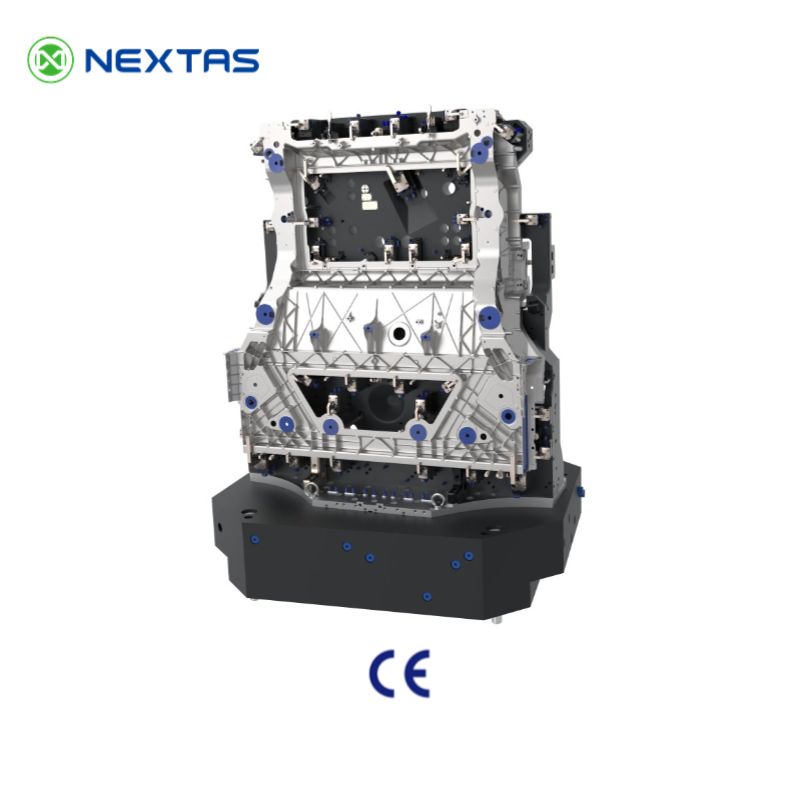

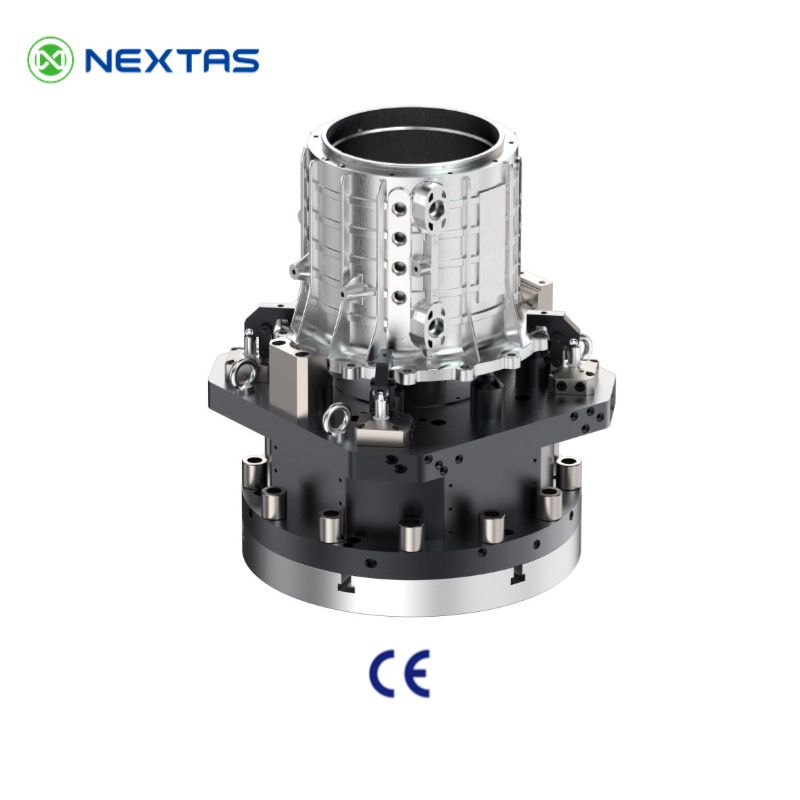

Custom Workholding Solution
Custom Hydraulic Fixture Systems for Multi-Station CNC Production
Engineered workholding for stable clamping, CTQ protection and automation-ready machining flow.
Choose a custom hydraulic fixture when the part family, datum chain, or takt target no longer fits a standard vise or modular clamp. Nextas engineers the locating logic, clamping points, hydraulic circuit, and automation handoff around the real cutting sequence so the fixture supports the process instead of forcing compromises.
Part-specific locator strategy
Hydraulic + sensor integration
Robot / APC-ready concepts
Best fit
Use this route when the fixture must be built around the part, not chosen from a shelf
A strong fit for multi-station machining, protected datums, thin-wall parts, and projects where locating logic, chip protection, or automation sensing must be engineered together.
Start here
Bring the part family, operation sequence, and machine constraints first
That input usually clarifies whether the concept needs swing clamps, work supports, pull-down logic, sensor feedback, pallet coupling, or a more service-friendly manifold design.
Jump in by task
Use the page to qualify the project before sharing drawings
Start with the section that matches the current discussion: fit and use-case screening, engineering inputs, evaluation checklist, or technical reference.
Selection focus
Check whether the project really needs custom locator architecture, hydraulic force control, or a family-of-parts strategy instead of a standard catalog vise.
Engineering focus
Review machine access, datum protection, circuit concept, sensing, coolant exposure, and whether robot or pallet interfaces must be built in from day one.
Evaluation focus
Use the checklist and spec sections to prepare the drawings, CTQ notes, takt expectations, and maintenance constraints that shorten concept review time.
Fast engineering handoff
Send the process constraints first
- Part family, operation order, and protected CTQ datums.
- Machine model, pallet standard, and tool-access limits.
- Hydraulic source, sensing requirement, and maintenance preference.
- Cycle-time target plus robot or APC integration plan.
When a Custom Hydraulic Fixture FitsArchitecture & OptionsEngineering & Integration GuideTroubleshooting & MaintenanceDesign & Engineering WorkflowTechnical Specifications
When a Custom Hydraulic Fixture Fits
A customized hydraulic fixture (hydraulic workholding system) uses controlled hydraulic pressure to clamp and locate your workpiece with repeatable force. Compared with manual or purely mechanical workholding, hydraulic clamping fixtures reduce setup time, stabilize critical datums, and integrate cleanly with pallet changers and robotic loading—ideal for high-volume CNC production and precision parts.
Repeatability
≤0.005 mm (typical)
Clamping Force
5–200 kN (application dependent)
Pressure Range
10–70 MPa
Automation Ready
Quick couplings + PNP/NPN sensors
Best fit scenarios
- High-volume machining cells with APC/palletization or robot loading
- Thin-wall, high-value, or complex parts that need even, controlled clamping to avoid distortion
- Multi-op processes where repeatable datum transfer and cycle stability matter
- Part families that benefit from modular locators and quick changeover
Core Advantages
Custom hydraulic fixtures deliver high clamping force with precise, repeatable positioning—designed to eliminate tool slippage and maintain accuracy through aggressive CNC operations.
Reliable Clamping Force
Delivers high, evenly distributed hydraulic pressure for secure workholding, eliminating slippage even during aggressive cutting.
Consistent High Precision
Delivers solid positioning repeatability (≤.005mm), so every part is machined to exact specifications.
Designed for Automation
Features integrated ports and sensors for clamp/unclamp confirmation, enabling straightforward use with robotic and FMS systems.
Durable & Robust Construction
Built from high-grade, heat-treated alloy steel to withstand the harshest production environments and deliver long-term reliability.
Architecture & Options
We engineer the locating scheme, clamping elements, hydraulic circuit, and automation interfaces as one system—so you get repeatability, rigidity, and maintainability without compromising tool access or chip evacuation.
Clamping modules (application-specific)
- Swing clamps / pull-down clamps / toe clamps
- Hydraulic work supports and anti-lift elements
- Single-acting or double-acting cylinders, self-locking options
- Dedicated clamping for OD/ID features, collet/pull-back concepts (when required)
Locating & rigidity strategy
- 3-2-1 datum locating or CTQ-driven custom schemes
- Hardened, replaceable locators and wear pads for long life
- Rigid base design to resist vibration and heavy cutting loads
- Tool-clearance and chip/coolant flow considered from day one
Automation & process monitoring
- Hydraulic quick couplings and standardized manifolds
- Part-present and clamp-position feedback (PNP/NPN)
- Pressure confirmation and interlocks for unattended machining
- Pallet/zero-point interfaces available for rapid fixture exchange
Hydraulic circuit options
- Single-zone or multi-zone clamping (independent control for critical features)
- Sequence valves for safe clamp order and controlled release
- Integrated manifolds to reduce external plumbing and leak points
- Rotary unions and through-pallet routing for palletized automation (as needed)
Sealing, coolant & chip protection
- Seal selection matched to your hydraulic media and coolant environment (e.g., NBR/Viton options)
- Surface treatments for corrosion and wear resistance (black oxide, nitriding, nickel plating—optional)
- Chip guards and service-friendly routing to simplify maintenance
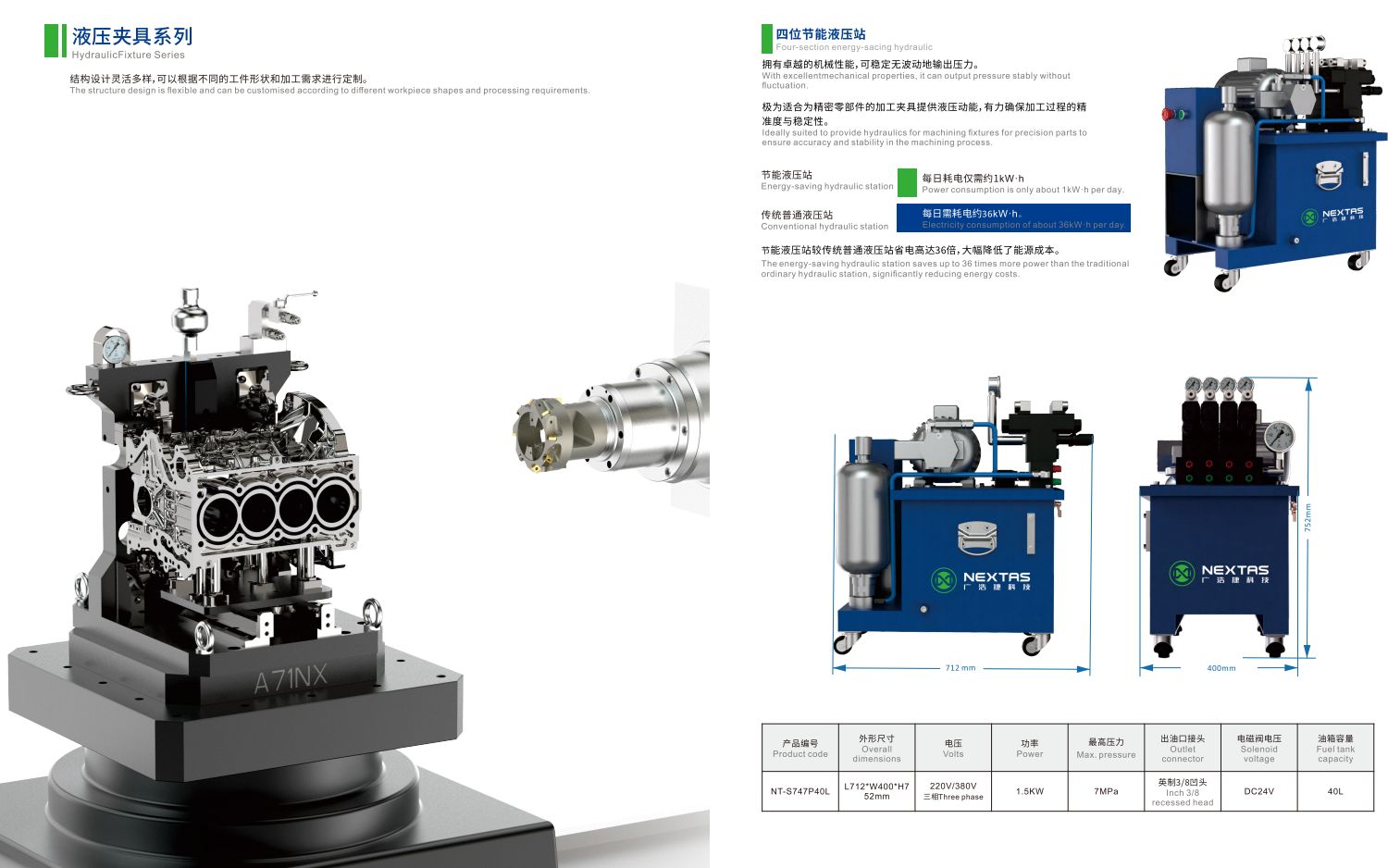
Matching Hydraulic Power Unit — NT-S747P40L
Every customized hydraulic fixture needs a matched power source. The NT-S747P40L four-station energy-saving hydraulic station is the standard HPU in the Nextas 2025 catalogue — sized to drive multi-clamp fixtures, automated pallet cells, and palletized production lines with stable pressure and low idle consumption.
Technical Specifications
| Parameter | NT-S747P40L |
|---|---|
| Product code | NT-S747P40L |
| Stations | Four-station, energy-saving design |
| Motor power | 1.5 kW |
| Working pressure | 7 MPa |
| Tank capacity | 40 L |
| Inlet / outlet | 3/8" recessed (inch) connection |
| Control voltage | DC 24 V |
Specifications per Nextas Workholding & Automation Solution Catalogue 2025II. Other pressure, tank size, or station counts are available on request for dedicated fixtures or multi-machine pallet cells.
Why this HPU pairs with our fixtures
- Four-station outlet block supports parallel clamp / unclamp on multi-feature fixtures without plumbing workarounds.
- Energy-saving circuit holds clamp pressure with minimal idle current — suitable for long hold times on machining centers.
- 24 VDC control matches common machine M-code signals, PLC interlocks, and automated cell controllers.
- 7 MPa working pressure is sized for most pneumatic-to-hydraulic conversions, swing-arm clamps, and pallet locking circuits.
Engineering & Integration Guide
A customized hydraulic fixture is more than a clamp—it's a production system. The right circuit design, sensing, and pressure strategy improves repeatability, reduces distortion, and keeps automated loading safe and reliable.
Input checklist (before design freeze)
These details let us size clamping forces, pick the right hydraulic workholding architecture, and avoid late rework.
| Design input | Why it matters | Typical notes / options |
|---|---|---|
| Part drawing + CTQs (critical-to-quality) | Defines datums, functional faces, and where distortion is unacceptable. | 3-2-1 locating, datum targets, surface finish limits, inspection plan |
| Machining ops & tool access (3-axis / 5-axis) | Prevents tool collisions, keeps chip evacuation and coolant flow working. | Tool approach directions, keep-out zones, probing requirements |
| Production goals (takt time, changeover, automation) | Drives quick-change features and modular elements for family parts. | Palletized automation, robot loading, quick couplings, poka-yoke |
| Hydraulic supply & controls | Sets pressure/flow limits and how clamp/unclamp is commanded. | Central HPU, machine M-code, quick couplings, pressure confirmation |
| Clamping zones & sequencing | Helps protect thin walls and improves consistency on complex parts. | Multi-zone clamping, staged pressure, pressure-reducing valves |
| Sensors & interlocks | Required for safe automated manufacturing and fault-proofing. | Part-present, clamp position, pressure switch, PLC I/O (PNP/NPN) |
| Coolant / chips / environment | Impacts sealing, protection, and long-term reliability. | Chip guards, wipers, corrosion protection, service access |
| Maintenance preference | Keeps uptime high with predictable servicing. | Cartridge seals, accessible ports, spare seal kits, modular clamps |
Circuit & manifold options (match your line)
We choose a hydraulic circuit that balances rigidity, serviceability, and automation integration—especially for palletized or high-mix production.
| Option | Best for | Notes |
|---|---|---|
| Manifold-in-base (internal channels) | High-volume production, clean layouts, fewer leak points. | Add service ports; protect against contamination; easy automation routing |
| External hose plumbing | Prototypes/low volume jobs that may change. | Fast to modify; protect hoses from chips and tool contact |
| Single-acting clamps (spring return) | Simple circuits and strong fail-safe behavior. | Confirm full unclamp; consider pressure confirmation for cycle start |
| Double-acting clamps | Fast cycle time and positive unclamp on sticky parts. | More plumbing; ideal when evacuation is critical |
| Self-locking / pressure-retaining clamps | Higher safety during power loss or line pressure drops. | Define release procedure; verify with safety requirements |
| Multi-zone with staged pressure | Thin-wall parts or sensitive CTQs. | Reduces distortion; tune zone pressures for repeatable results |
Troubleshooting & Maintenance
Common issues in CNC hydraulic fixtures are predictable. This quick table helps your team diagnose problems fast and protect repeatability.
| Symptom | Likely cause | Recommended action |
|---|---|---|
| Clamping force inconsistent | Air in circuit, pressure drop, sticky valve, worn seals. | Bleed system; verify HPU pressure/flow; check valves; replace seals if needed. |
| Part movement / chatter marks | Insufficient support, poor locator strategy, clamp point too far from cutting forces. | Add work supports; revise locating scheme; reposition clamps; review cutting parameters. |
| Oil leakage around cylinder | Worn seal, surface damage, contamination, incorrect torque. | Replace seals; inspect rod/surface; improve filtration; re-torque fittings. |
| Slow clamp/unclamp | Flow restriction, clogged filter, long hoses, undersized quick couplings. | Check filters; shorten lines; upsize couplings; add flow control where needed. |
| Pressure OK but part distorts | Excess force or uneven load path. | Use staged pressure / multi-zone control; add hard stops; spread contact areas. |
| Sensor false alarms | Contamination, wiring noise, misalignment. | Improve IP protection; add shielding; adjust mounting; validate PLC logic. |
Preventive tips
- Keep hydraulic oil clean with proper filtration and regular checks.
- Inspect quick couplings and sealing surfaces during scheduled downtime.
- Verify pressure confirmation setpoints after maintenance or line changes.
Design & Engineering Workflow
Our process begins with your component. We collaborate closely with your engineering team to understand machining requirements, part geometry, and production goals to build a truly custom solution.
Design-to-Delivery Workflow (What You Can Expect)
A clear workflow reduces risk and accelerates commissioning—especially for automated CNC hydraulic fixtures.
-
1Requirements & CTQsPart drawings, machining ops, tolerance stack, target takt time, and automation constraints.
-
2Fixture concept & DFMLocator strategy, tool access, chip evacuation, and clamp selection to prevent distortion.
-
3Hydraulic circuit & safetyPressure targets, relief settings, clamp sequencing, and sensor planning for unattended runs.
-
4Manufacturing & inspectionHeat-treated locators, precision grinding, and dimensional verification on critical features.
-
5Assembly & validationLeak testing, clamp-force verification, and repeatability checks aligned to your acceptance criteria.
-
6Delivery & supportDocumentation (layout, BOM, routing), spares guidance, and commissioning support when required.
Typical engineering deliverables
- 2D layout + key-dimension drawings for review and sign-off
- Hydraulic schematic / manifold map and maintenance notes
- BOM and recommended spares (seals, wear pads, sensors)
- Validation plan aligned to your process capability needs
Advanced Hydraulic System
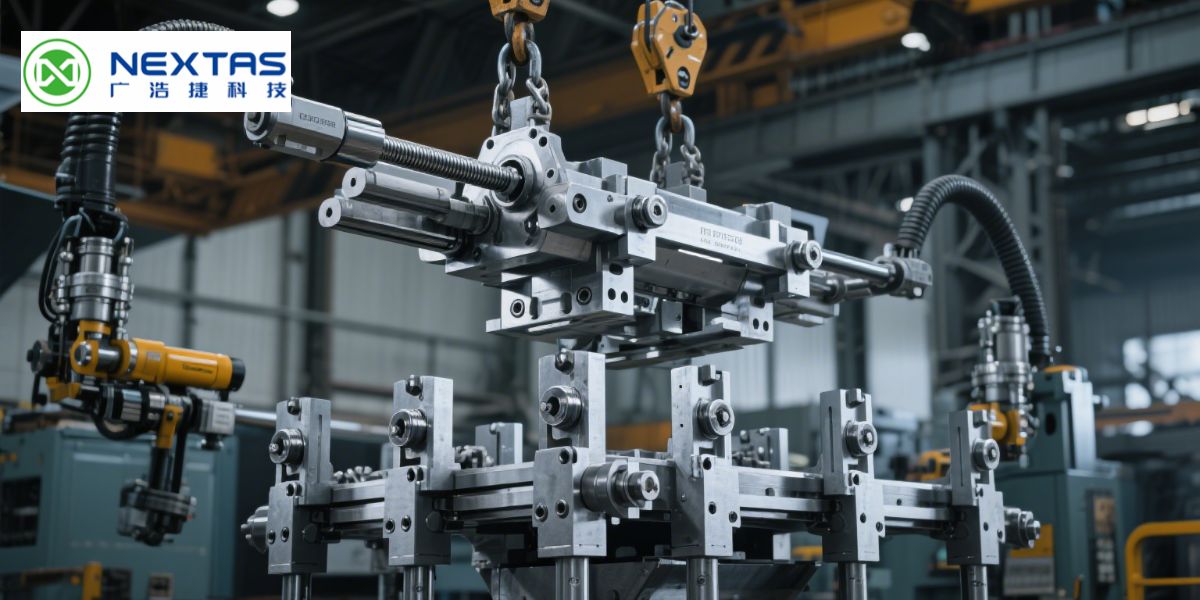
The core of our fixture is a high-pressure hydraulic system featuring hardened steel components and leak-proof seals. This keeps it working reliably with minimal maintenance over millions of cycles. The system is designed for rapid clamping and unclamping, minimizing non-productive time.
Modularity and Adaptability
Our fixtures are often designed with modularity in mind. Interchangeable clamping elements and locators allow a single fixture base to accommodate a family of parts, providing a cost-effective and flexible workholding solution for the future.
Technical Specifications
Note: These are typical specifications. All parameters are customized based on the specific application requirements.
| Parameter | Typical Specification Range |
|---|---|
| Positioning Repeatability | ≤0.005 mm |
| Clamping Force | 5 kN - 200 kN (application dependent) |
| Operating Hydraulic Pressure | 10 - 70 MPa (1450 - 10150 PSI) |
| Fixture Body Material | High-Grade Alloy Steel or Aircraft-Grade Aluminum |
| Clamping Components Material | Hardened Tool Steel (HRC 58-62) |
| Actuation | Single-acting or Double-acting Hydraulic Cylinders |
| Automation Interface | Hydraulic quick-couplings, Electrical sensors (PNP/NPN) |
| Clamp / Unclamp Time | Fast actuation (circuit-dependent; optimized for production throughput) |
| Clamping Zones | Single-zone or multi-zone (independent control) |
| Sensor & Feedback | Part-present, clamp position, pressure confirmation (options) |
| Quick-Change Interface | Hydraulic quick couplings; pallet/zero-point options |
| Surface Treatment (optional) | Black oxide, nitriding, nickel plating |
| Hydraulic Media Compatibility | Mineral oil; water-glycol (by seal selection) |
Product Data & Evaluation Checklist
Custom fixtures win when the supplier documents assumptions and provides measurable results with proof.
Information to share for a fast quote
- 2D/3D part drawings (STEP/IGES), material, and heat-treatment notes
- Machining operations (op sequence), critical datums/CTQs, and tolerance requirements
- Annual volume / batch size, target cycle time, and changeover goals
- Machine model, pallet size/standard, and available envelope / tool access limits
- Automation plan (robot/APC), desired sensors, and coolant/cleaning conditions
- Available hydraulic supply (pressure/flow) or preference for an external power unit
Key specifications
| Fixture type | Customized hydraulic fixture system |
|---|---|
| Clamping force | High-force hydraulic clamping (targets set per part/process) |
| Precision goal | Designed for consistent location in automated production |
| Automation fit | Ready for lines/cells; supports repeat cycles |
| Modularity | Maintainable design and future SKU expansion |
| Deliverables | Layout drawing, BOM, routing, and validation plan |
Tip: share your part material, machine model, and target takt time. We’ll propose the right configuration and measurable targets.
Compatibility & standards
- Designed around your machine envelope, pallet standard, and part datum scheme.
- Pairs with zero-point bases/APC pallets for fast fixture exchange (optional).
- Supports multi-op processes and robotic loading with sensor planning.
Measured outcomes (before → after)
- Setup time reduced via standardized clamping and documented procedures.
- Yield improvement: fewer clamp-related deviations and rework.
- Cycle stability: consistent clamping and repeat location over long runs.
Workholding configuration
- BOM: cylinders, manifolds, valves, locators, clamps, sensors, plumbing.
- Datum & locator scheme: 3-2-1 or custom strategy based on CTQs.
- Hydraulic routing: pressure targets, safety relief, maintenance access.
Evidence & proof
- Design package: 2D layout + key 3D screenshots for buyer review.
- Tryout video: clamp sequence and cycle demo on sample part.
- Inspection excerpt: before/after comparison on critical dimensions (CTQs).
Delivery & support
- Project workflow: DFM review → design freeze → build → tryout → shipment.
- Remote commissioning support and on-site options.
- Spare parts list and preventive maintenance guidance included.
Proven Success in Demanding Industries
Our hydraulic fixtures are trusted by leaders in automotive, aerospace, and heavy machinery for their most critical machining operations.

Automotive Powertrain
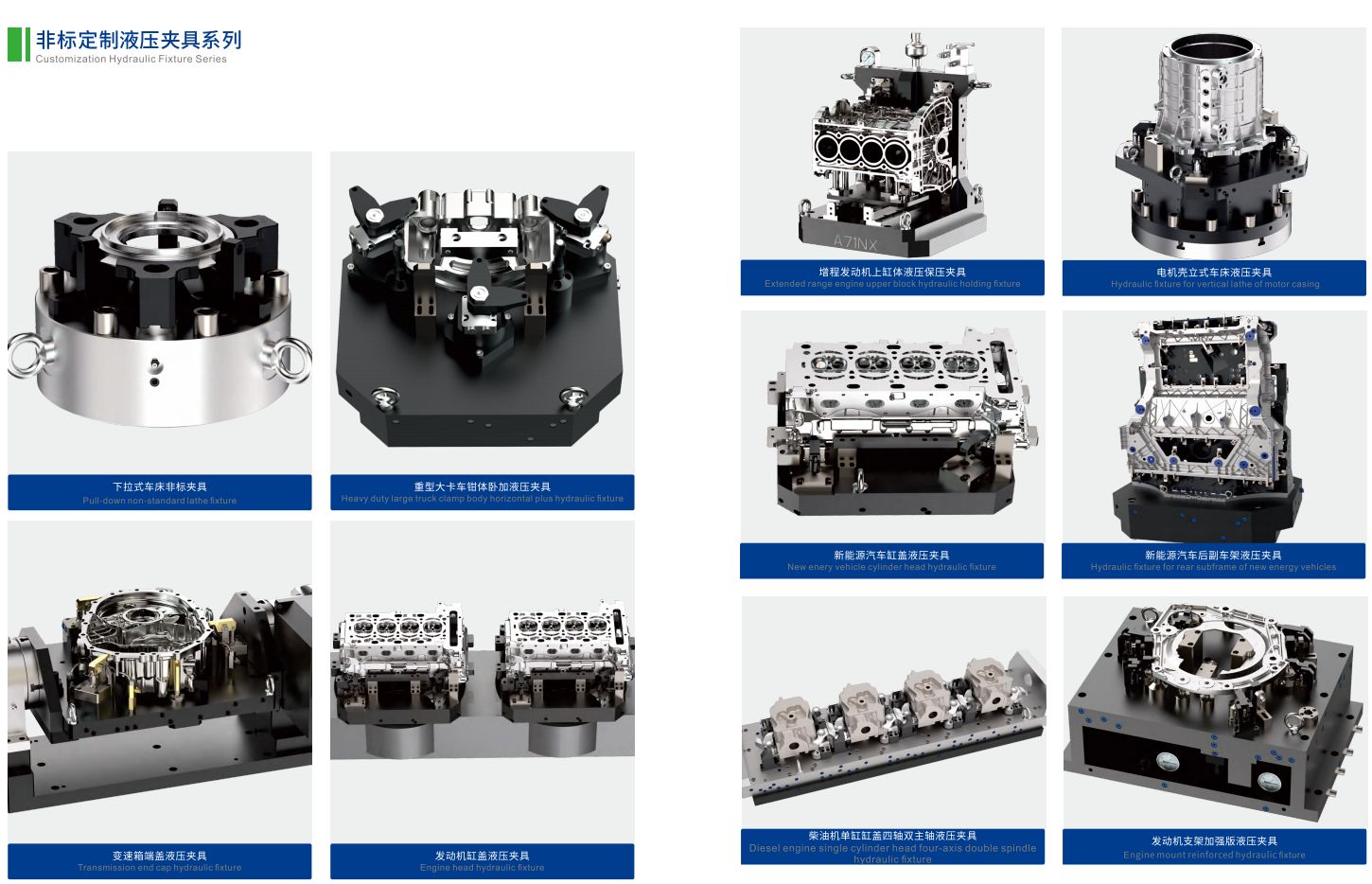
The industry standard for machining engine blocks, cylinder heads, and transmission cases. Our fixtures provide the rigidity and precision to hold tight tolerances on critical features for performance and reliability.
Aerospace & Defense
From structural airframe components to complex turbine blades, our fixtures securely hold thin-walled or exotic materials without distortion. We provide proven solutions for 5-axis machining of titanium, Inconel, and high-strength aluminum alloys.
Heavy Machinery & Energy
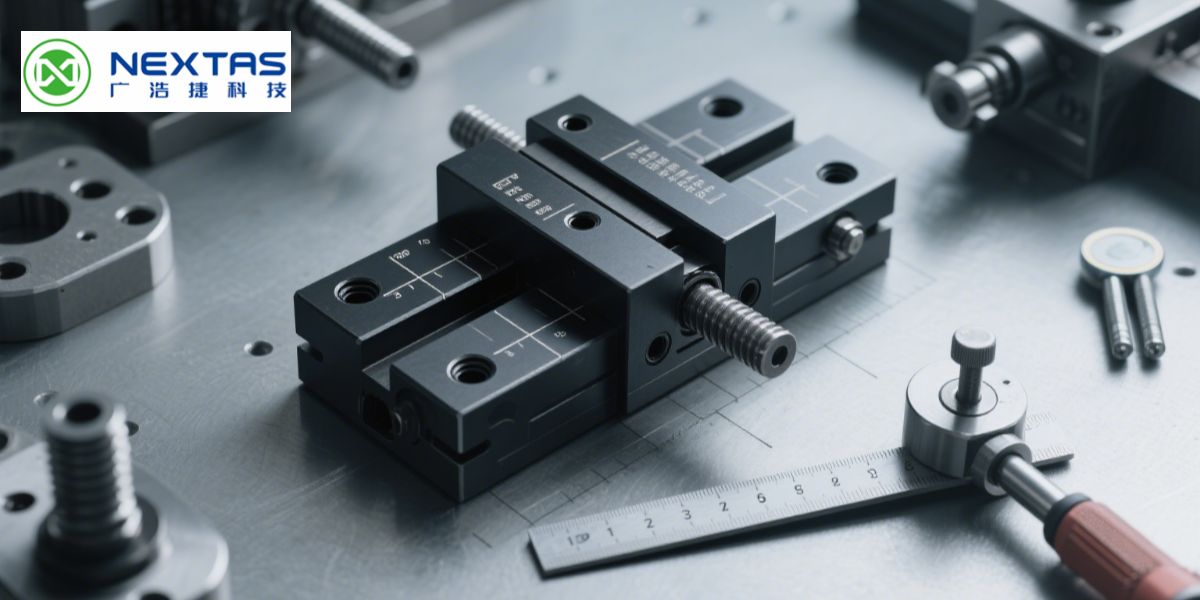
We design robust fixtures for large workpieces like hydraulic manifolds, valve bodies, and gear housings. Our solutions are built to handle heavy parts and high metal removal rates, maximizing throughput in demanding production environments.
Resources
Download brochures, request CAD models, or get a consultation for your custom hydraulic fixture project.
Engineering intake
Share your fixture project requirements
Hydraulic fixture projects move faster when the request already includes the part family, datum strategy and target machining problems. This form sends those details together with the product context, so your inquiry is easier to classify and reply to.
Part material, size and batch level
Machine type, pallet or tombstone constraints
Main pain point: distortion, changeover, access or automation
Preferred deliverable: concept review, quote, or CAD discussion
Request hydraulic fixture review
Use this when you want a more qualified engineering reply than a general contact message.
Selection • Integration • Maintenance Cheatsheet
A compact, shop-floor reference to help you choose the right configuration, integrate cleanly with your machine/automation, and keep repeatability stable in daily production.
1) Selection: pick the right configuration
| If you care most about… | Start with… | Why this helps |
|---|---|---|
| Fast changeovers / high-mix jobs | Standardize one interface (zero-point / ITS / 3R) across machines + build fixture plates/pallets. | Enables offline setup and swaps in seconds with minimal re-indicating. |
| 5-axis access and tool clearance | Choose low-profile components and plan clearance early (stack height, clamp body, wrench access). | Avoids collisions and preserves reach for deep features. |
| Lights-out / robot-tended machining | Add confirmations (clamp-OK / part-present), chip protection, and a recovery sequence. | Reduces mis-load risk and improves automation reliability. |
| Heavy roughing / high cutting forces | Increase support points and rigidity (more clamping stations, stiffer base, shorter stack-up). | Minimizes deflection and protects surface finish. |
2) Integration: what to prepare before install
| Item | Typical choice | Practical tip |
|---|---|---|
| Mounting and datums | Bolt pattern + dowel pins / keyways / reference edge | Define a master datum and keep a gauge pallet/part for quick verification. |
| Utilities | Clean, dry air with FRL; stable pressure; (hydraulic/electrical if used) | Drain FRL regularly and avoid long, restrictive hoses that slow actuation. |
| Control handshake | M-codes/PLC I/O: clamp, unclamp, clamp-OK, fault | Use timeouts + safe states; log signals to diagnose intermittent downtime. |
| Process validation | Probe macro / indicator check / first-article routine | Baseline repeatability after installation, then compare weekly. |
3) Maintenance: keep repeatability stable
| Risk / wear point | Early symptom | Prevention / quick fix |
|---|---|---|
| Chips on locating surfaces | Parts shift, repeatability drifts | Air-blow + wipe seating faces; add chip covers/air blast if needed. |
| Seals/wipers and sliding surfaces | Slow actuation, leaks, inconsistent clamp | Inspect on schedule; keep coolant/abrasives out; replace wear items proactively. |
| Loose fasteners / damaged contact faces | Unexpected misalignment, vibration marks | Torque-check; use dowels; stone minor nicks (don’t ‘machine’ the datum). |
| Contaminated air/oil | Sticky motion, alarms in automation | Improve filtration, dry air, drain bowls; keep a simple spare-kit. |
Need CAD/STEP, a mounting pattern, or a recommended setup for your part?
Contact usFrequently Asked Questions
Answers to common questions about custom hydraulic fixtures, CNC hydraulic workholding, and automation integration.
What is a custom hydraulic fixture system?
It’s a CNC workholding solution designed around your specific part and process. Using hydraulic pressure, it clamps with repeatable force and locates datums consistently—ideal for automated or high-volume production.
How is hydraulic workholding different from pneumatic or mechanical clamping?
Hydraulic fixtures typically deliver higher and more stable clamping force than pneumatic systems, with better control for thin-wall parts. Compared with manual/mechanical clamps, they reduce operator variation and improve repeatability in long runs.
Which clamp styles can you integrate?
Depending on the part, we can integrate swing clamps, pull-down/toe clamps, hydraulic work supports, cylinders, and anti-lift elements. The clamp choice is driven by access, distortion risk, and required cutting loads.
Can one fixture handle a family of parts?
Yes. We often design modular locators and interchangeable clamping elements so a base fixture can accommodate part variants with minimal changeover time.
How do you prevent part distortion?
We balance clamping points, control force with the hydraulic circuit, and design locators around critical-to-quality features. For thin-wall parts, even-force strategies and support elements are used to maintain geometry.
What information do you need to start a design?
Part drawings (2D/3D), machining ops, datum/CTQ requirements, machine/pallet constraints, automation plan, and production targets (volume, takt time). The more complete the inputs, the faster we can converge on a robust concept.
How do you integrate with automation?
Fixtures can be designed for pallet changers and robotic cells with quick couplings, standardized manifolds, and sensor feedback (part-present, clamp position, pressure confirmation) for safe unattended machining.
What maintenance is typically required?
Routine checks focus on seals, hydraulic connections, and sensor condition. Service-friendly routing and replaceable wear pads help keep preventive maintenance quick and predictable.
Related Solutions

Zero-Point Clamping System
The perfect base for our hydraulic fixtures, enabling rapid changeovers with ±0.002mm repeatability.
View Details →
Self-Centering Vise
Ideal for 5-axis machining of smaller, prismatic parts with high precision.
View Details →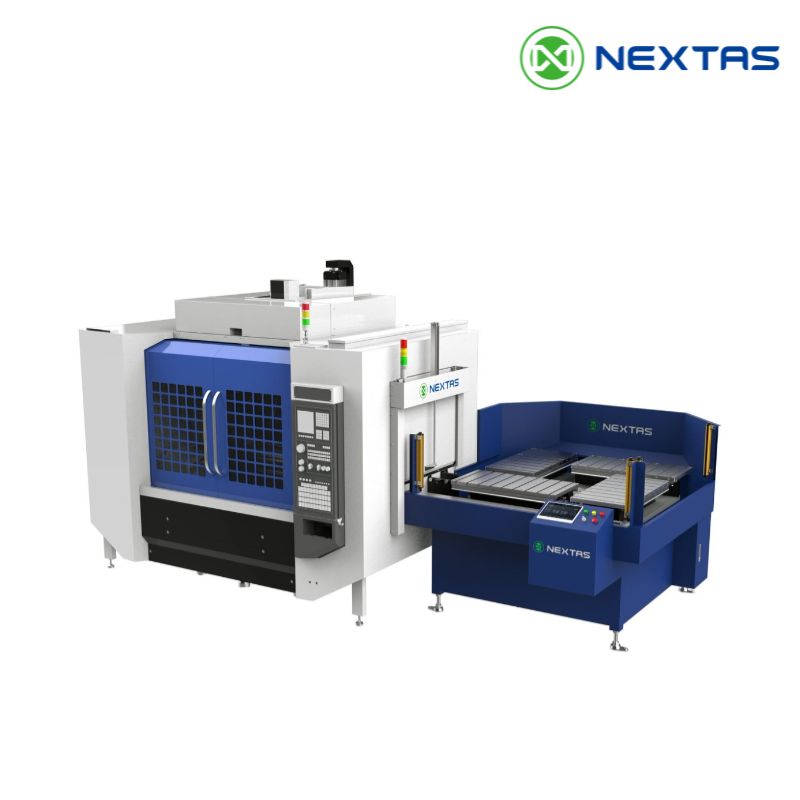
Automatic Pallet Changer
Maximize machine uptime by integrating your hydraulic fixtures with our APC systems.
View Details →