
 English
 Español
 Français
 Deutsch
 Polski
 Türkçe
 Русский
 简体中文
简体中文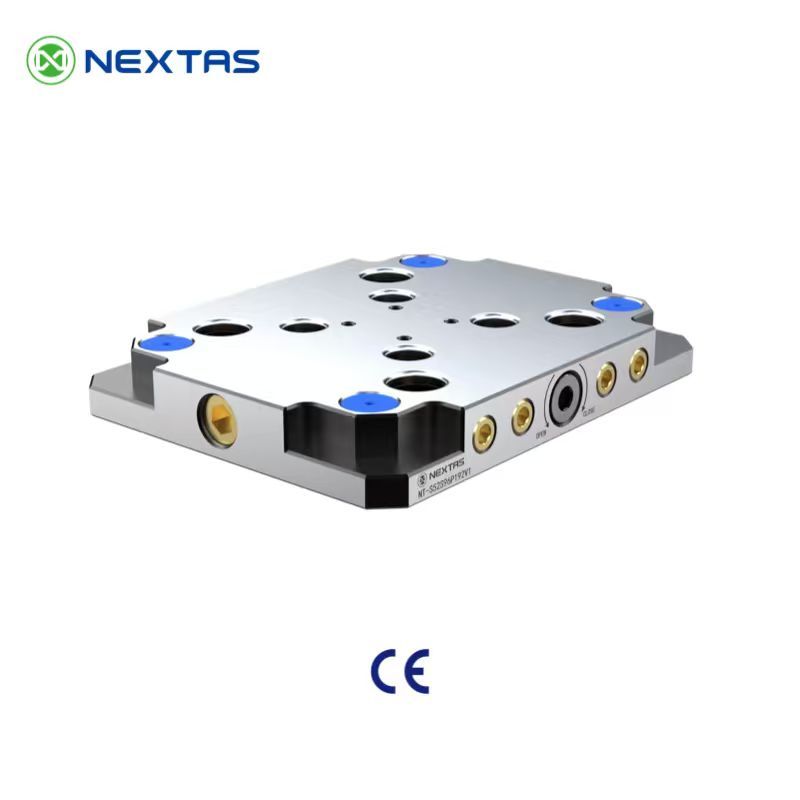

Enter your email address to request the brochure. Due to time zone differences, we’ll email it the next business morning (GMT+8, Beijing Time).
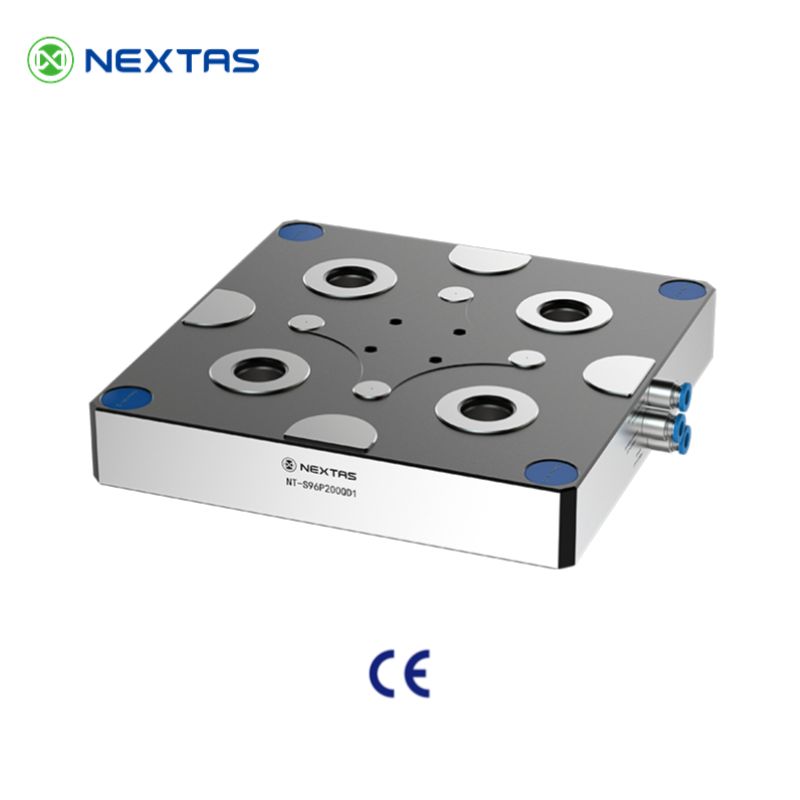

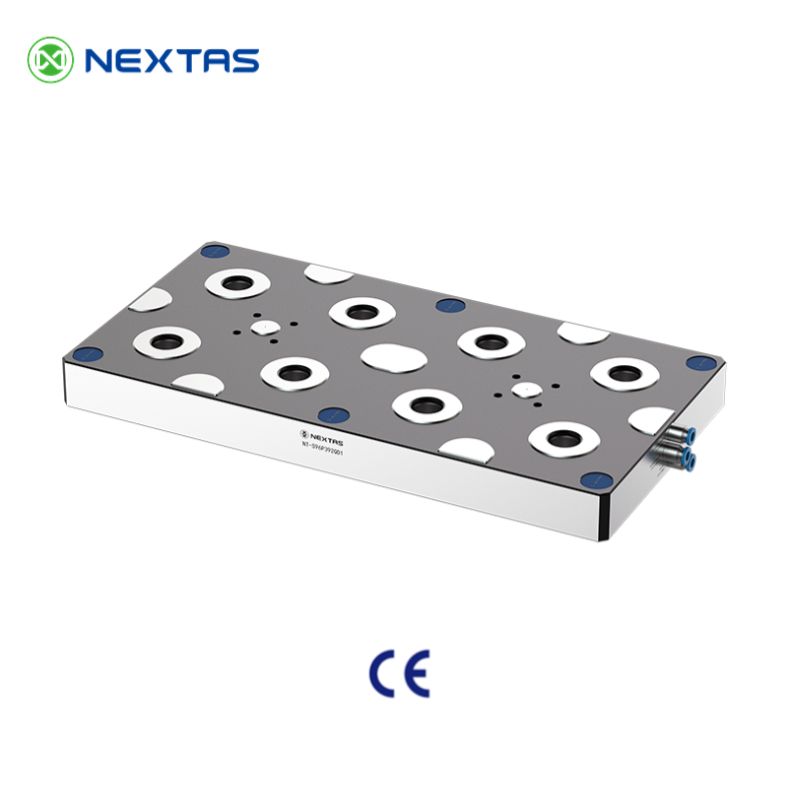
Quick Changeover System
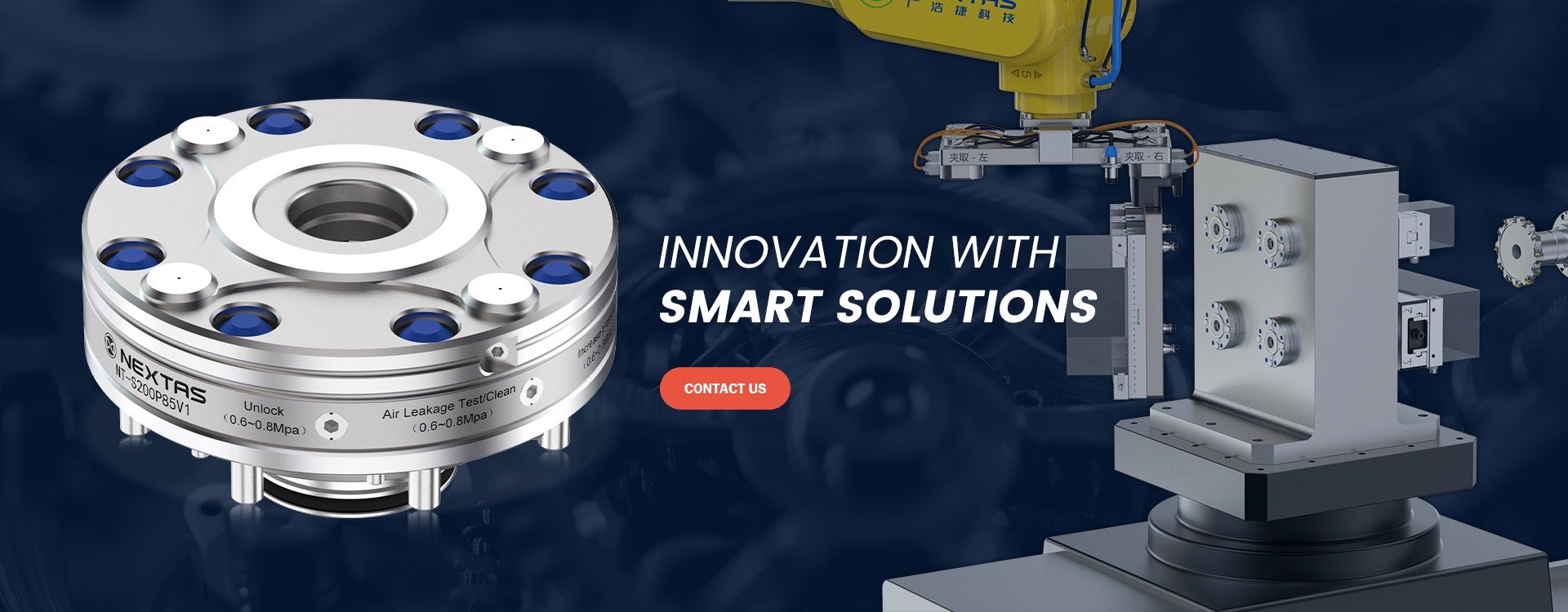
Pneumatic Zero-Point Plate
Air-actuated zero-point plate for robot loading, pallet transfer and automation-ready fixtures
The Nextas Pneumatic Zero-Point Plate creates a precise and repeatable foundation on your machine table, allowing fixtures and workpieces to be changed in seconds, not hours. By standardizing your setup process, you reduce downtime and keep machines cutting instead of waiting for setups. When you need unattended operation, the same interface works with robots and APC systems.
Micron-Level RepeatabilityGuarantees a repeat positioning accuracy of ≤0.005mm, eliminating realignment.
Massive Clamping ForceFailsafe spring mechanism ensures rigid clamping even during heavy cutting.
Seconds to ChangeoverPneumatic unlocking for near-instantaneous clamping, minimizing downtime.
Best fit
Choose this plate when uptime loss comes from fixture swaps
Best for palletized tombstones, robot-loaded fixtures, and repeat jobs where the machine should stop waiting for re-indicating.
Compare first
Confirm pull-stud standard, station count, and air logic
Most buyers decide faster once 52 / 96 mm spacing, fixture footprint, and air or sensor needs are clear before going deeper into tables.
Need next
Jump straight to the decision sections
Use the quick links below to compare selection, integration, and maintenance without getting lost in the full page.
Main FeaturesTechnical Specifications & DesignAutomation IntegrationVersatile Application ScenariosProven Results: Case StudySelection & Integration Guide

Main Features
- Patented New Product: An innovative, globally debuted product with unique technological advantages.
- Standard Compatibility: Adopts 52/96 mm standard pitch for universal compatibility with other workholding products.
- Ultra-High Precision: Repeat positioning accuracy of less than 0.005mm for the most demanding tasks.
- Model Range Performance: Depending on the pallet size, clamping force ranges from 9,000 N to 40,000 N and lifting load ranges from 100 kg to 660 kg.
- Enhanced Reliability: Equipped with air tightness testing and cleaning functions for robust operation.
- Strengthened Clamping: Air pressure boosting function strengthens clamping force, improving stability.
- Convenient Operation: Automatically lifts the vice/pallet when unlocked for efficient operation.
Technical Specifications & Design
Precision positioning repeatability (≤.005mm) combined with rapid changeover capability for automated palletized CNC systems—sealed against coolant and chips for reliable operation.
Series Specification Snapshot
Reference models aligned with the current catalogue. 52 mm and 96 mm interfaces are both available for automated pallet, fixture, and robot-ready changeover planning.
| Model | Stud standard | Repeatability | Clamping force | Lifting load | Unlocking pressure | Spigot | Weight |
|---|---|---|---|---|---|---|---|
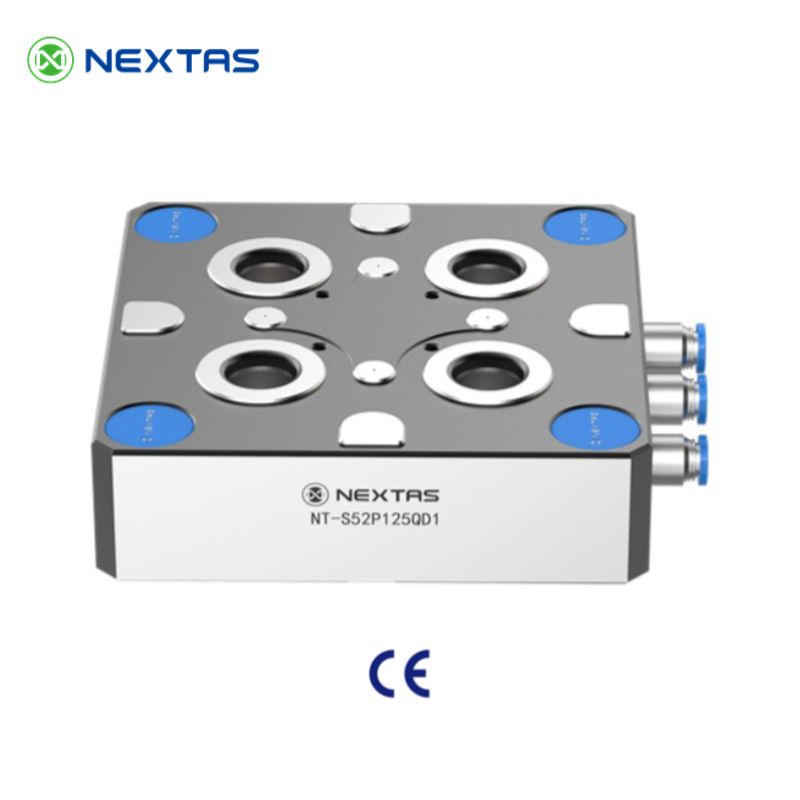
| NT-S52P125QD1 | 52 mm | ≤0.005 mm | 9,000 N | 100 kg | 0.5–0.8 MPa | NT-S52P16V1 | 3.5 kg |
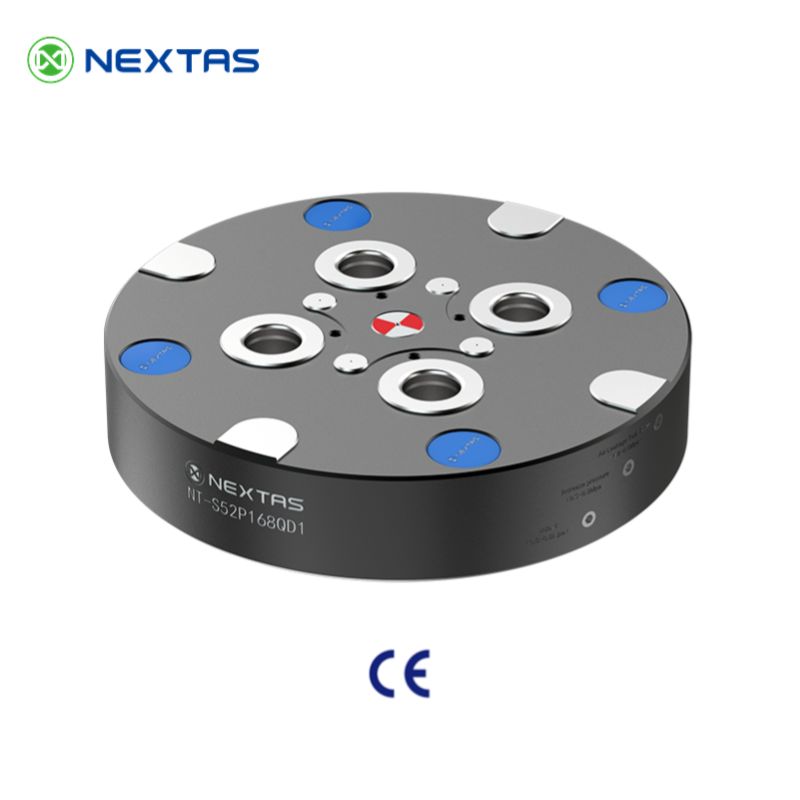
| NT-S52P168QD1 | 52 mm | ≤0.005 mm | 9,000 N | 100 kg | 0.5–0.8 MPa | NT-S52P16V1 | 5.2 kg |
| NT-S52P229QD1 | 52 mm | ≤0.005 mm | 18,000 N | 200 kg | 0.5–0.8 MPa | NT-S52P16V1 | 6 kg |
| NT-S96P200QD1 | 96 mm | ≤0.005 mm | 20,000 N | 330 kg | 0.5–0.8 MPa | NT-S96P20V1 | 9 kg |
| NT-S96P250QD1 | 96 mm | ≤0.005 mm | 20,000 N | 330 kg | 0.5–0.8 MPa | NT-S96P20V1 | 12 kg |
| NT-S96P392QD1 | 96 mm | ≤0.005 mm | 40,000 N | 660 kg | 0.5–0.8 MPa | NT-S96P20V1 | 18 kg |
All reference models use hardened stainless steel bodies, pneumatic unlocking, mechanical self-locking structure, clamping pressurization, positioning datum self-cleaning, air-tightness testing, and 4 × 90° fixed indexing.

Precision by Design
The Nextas system uses pneumatic pressure to enable, while powerful internal springs drive the clamping slides. This pulls positioning studs into tapered locating cones, creating a secure, vibration-dampening connection with a precisely defined zero-point. The "normally locked" state ensures force is maintained even if air pressure is lost, guaranteeing safety.
Built for the Modern Shop Floor
Constructed from hardened, corrosion-resistant stainless steel, our zero-point plates are built to withstand the rigors of any manufacturing environment. The system is fully sealed to protect the internal mechanism from chips, coolant, and other debris. Integrated air-blast channels automatically clear the locating cones of any contaminants before clamping, so the ≤.005mm repeatability stays consistent every single time.

Lights-Out Manufacturing Through Unified Interfaces
By providing a common, high-precision interface on all your machines—from milling centers to EDMs to CMMs—palletized workpieces can be moved between operations by a robot, clamped with repeatable accuracy, and machined without operator intervention. This is how automating end-to-end works.
Why this platform works
Core Advantages
Placed here on purpose so buyers can review the hard technical details first, then connect them to the production gains they are targeting.
Micron-Level Repeatability
Guarantees repeat positioning accuracy of ≤0.005 mm, helping eliminate manual realignment across repeated setups.
Massive Clamping Force
Failsafe spring locking keeps the interface rigid during aggressive cutting and protects uptime during air interruption.
Seconds to Changeover
Pneumatic unlocking makes near-instant swaps practical, reducing idle spindle time between parts, pallets, and fixtures.
Automation Ready
Integrated air sensing and cone-cleaning support simplify robotic loading and make unattended cycles more reliable.

Automation Integration
Nextas Pneumatic Zero-Point Plate streamlines robot automation: it synchronizes with robotic arms for fast, error-free workpiece or fixture swaps, drastically reducing manual setup time. Across the reference range, clamping force spans from 9,000 N to 40,000 N with lifting loads from 100 kg to 660 kg, giving robots a stable interface for both compact fixtures and heavy pallet transfers.
The precision interface ensures consistent accuracy so robots can repeat tasks without any re-calibration. By linking robots to machining tools for smooth, unattended factory workflows, the system enables 24/7 lights-out operation.
Versatile Application Scenarios
From single-machine efficiency to fully automated production lines, our system adapts to your needs.
Horizontal Machining Centers (HMC)
Perfect for pallet pools on HMCs. Prepare fixtures offline and load them onto the pallet changer so the machine stays in cutting mode.
5-Axis Machining
Raises the workpiece off the table, providing superior tool access to all five sides of a part, eliminating multiple setups.
Automated Production Cells
The core of any flexible manufacturing system (FMS). Robots can reliably exchange entire fixtures for unattended, 24/7 production.
Inspection & Quality Control
Use the same zero-point reference on your CMM. Transfer parts directly from CNC to inspection without re-clamping, eliminating errors.
Proven Results: Case Study
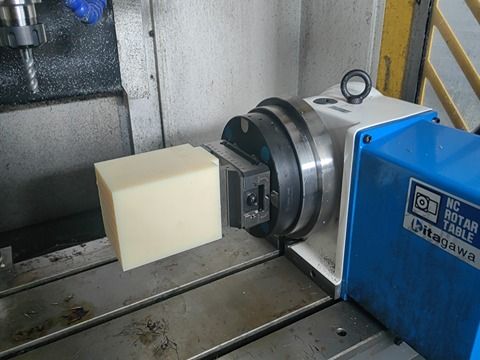
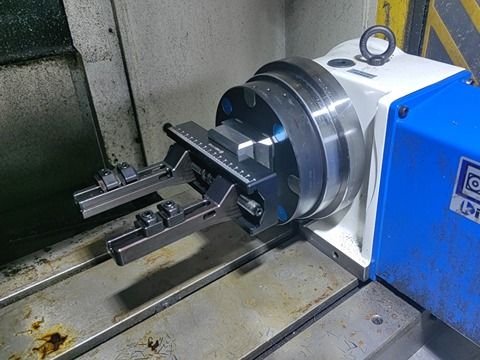
Our system enables rapid changeover in industrial manufacturing, boosting changeover efficiency by over 90% and production efficiency by more than 30%.

Selection & Integration Guide
A practical checklist for choosing a pneumatic zero-point plate (air-released, spring-locked) and integrating it into pallet systems, APCs, and robotic cells.
Need pallet automation? Pair it with our Automatic Pallet Changer for higher spindle uptime.
When a pneumatic zero-point plate is the right fit
- You need repeatable re-clamping for multi-op CNC machining (e.g., milling → EDM → CMM).
- You’re building palletized workholding for an HMC pallet pool or a 5-axis tombstone/fixture stack.
- Your goal is lights-out automation: robot fixture change, automatic pallet changer (APC), or FMS.
- You want a fail-safe concept: clamp is maintained by springs; air is used only to enable.
Key details to confirm before purchase
- Pull-stud standard & pitch: 52 mm / 96 mm compatibility across your fixtures.
- Module count & layout: 4-module, 6-module, or custom patterns for your pallet size.
- Repeatability target: ≤0.005 mm class performance for datum consistency.
- Clamping force & rigidity: evaluate cutting forces, overhang, and fixture stack-up.
- Pneumatic interface: operating pressure (typically around 6 bar) and air routing protection.
- Automation signals: clamp/unclamp confirmation, interlocks, and cone-cleaning air blast options.
Pallet & fixture interface
Standardize pull studs on every pallet/fixture so operators can set up offline and “drop-on & clamp” on any machine. Add dowel/locating pins for initial plate alignment and consistent pallet orientation.
Air & I/O integration
Use clean, dry compressed air and place a regulator close to the machine. For automation, add valve sequencing and I/O logic so the machine/robot only starts when clamp status is confirmed.
Process capability check
Validate repeatability over multiple cycles: clamp/unclamp, probe datum, and record deviations. This is the fastest way to prove a zero-point clamping plate is stable for your tolerance band.
Typical outcomes customers target
Setup time
From manual indicating and alignment to quick-change swaps measured in minutes—or less.
Quality stability
Less re-touching after re-clamp, especially for multi-operation workflows.
Automation readiness
A consistent, robot-friendly interface across CNC, EDM, and inspection.
Actual results depend on part geometry, fixture stack-up, cutting parameters, and your automation sequence.
Installation, Pneumatics & Maintenance
Practical notes for commissioning an air-released zero-point pallet plate and keeping repeatability stable over long production runs.
Installation & alignment (quick checklist)
- 1Clean the machine table and verify flatness/cleanliness where the plate will sit.
- 2Use locating pins/dowels for initial orientation so pallets repeat the same direction every time.
- 3Torque mounting bolts in a cross pattern; re-check after the first thermal cycle.
- 4Verify pull-stud height and fixture stack-up so every module seats fully in the locating cones.
- 5Run several clamp/unclamp cycles and probe a datum to confirm repeatability before production.
Air supply & reliability
- Use clean, dry, filtered air (plant standard). Add a regulator close to the machine.
- Protect hoses/couplers from chips and coolant; use strain relief in robot cells.
- For automation, wire a clamp-confirmed interlock so machining starts only when clamped.
- Use cone-cleaning air blast (if equipped) before clamping to prevent chip imprint errors.
- Schedule periodic inspection of cones, pull studs, and seals—especially in heavy coolant environments.
Common stability killers (and how to avoid them)
Chips in the locating cones
Use air blast + good coolant management; wipe cones during shift changes.
Inconsistent pull studs
Standardize stud type and installation torque across all fixtures/pallets.
Weak air pressure / leaks
Check regulators, couplers, and hoses; confirm pressure at the plate under load.
Fixture stack-up flex
Reduce overhang, add support, and validate rigidity for your cutting forces.
Selection • Integration • Maintenance Cheatsheet
A compact, shop-floor reference to help you choose the right configuration, integrate cleanly with your machine/automation, and keep repeatability stable in daily production.
1) Selection: pick the right configuration
| If you care most about… | Start with… | Why this helps |
|---|---|---|
| Fast changeovers / high-mix jobs | Standardize one interface (zero-point / ITS / 3R) across machines + build fixture plates/pallets. | Enables offline setup and swaps in seconds with minimal re-indicating. |
| 5-axis access and tool clearance | Choose low-profile components and plan clearance early (stack height, clamp body, wrench access). | Avoids collisions and preserves reach for deep features. |
| Lights-out / robot-tended machining | Add confirmations (clamp-OK / part-present), chip protection, and a recovery sequence. | Reduces mis-load risk and improves automation reliability. |
| Heavy roughing / high cutting forces | Increase support points and rigidity (more clamping stations, stiffer base, shorter stack-up). | Minimizes deflection and protects surface finish. |
2) Integration: what to prepare before install
| Item | Typical choice | Practical tip |
|---|---|---|
| Mounting and datums | Bolt pattern + dowel pins / keyways / reference edge | Define a master datum and keep a gauge pallet/part for quick verification. |
| Utilities | Clean, dry air with FRL; stable pressure; (hydraulic/electrical if used) | Drain FRL regularly and avoid long, restrictive hoses that slow actuation. |
| Control handshake | M-codes/PLC I/O: clamp, unclamp, clamp-OK, fault | Use timeouts + safe states; log signals to diagnose intermittent downtime. |
| Process validation | Probe macro / indicator check / first-article routine | Baseline repeatability after installation, then compare weekly. |
3) Maintenance: keep repeatability stable
| Risk / wear point | Early symptom | Prevention / quick fix |
|---|---|---|
| Chips on locating surfaces | Parts shift, repeatability drifts | Air-blow + wipe seating faces; add chip covers/air blast if needed. |
| Seals/wipers and sliding surfaces | Slow actuation, leaks, inconsistent clamp | Inspect on schedule; keep coolant/abrasives out; replace wear items proactively. |
| Loose fasteners / damaged contact faces | Unexpected misalignment, vibration marks | Torque-check; use dowels; stone minor nicks (don’t ‘machine’ the datum). |
| Contaminated air/oil | Sticky motion, alarms in automation | Improve filtration, dry air, drain bowls; keep a simple spare-kit. |
Need CAD/STEP, a mounting pattern, or a recommended setup for your part?
Contact usFrequently Asked Questions
What is a Pneumatic Zero-Point Plate and who is it for?
The Pneumatic Zero-Point Plate is a high-precision workholding foundation for CNC machines, designed for manufacturers aiming to automate, reduce setup times, and enhance accuracy.
What are the key specifications?
Key specs vary by model: 52/96 mm stud standards, ≤0.005 mm repeatability, 9,000 N to 40,000 N clamping force, 100 kg to 660 kg lifting load, pneumatic unlocking at 0.5–0.8 MPa, and integrated functions for air-tightness testing and cone cleaning.
Which machines is it compatible with?
It's compatible with 5-axis CNC centers, milling machines, EDMs, and CMMs, making it a versatile component for integrated manufacturing.
How is the Pneumatic Zero-Point Plate installed?
Installation is typically done via a standard bolt pattern onto the machine table. It connects to the machine's pneumatic interface for actuation and requires locating pins for initial alignment.
Where can I get CAD files or technical documentation?
For STEP/IGES models or 2D drawings, please contact our engineering team.
What's the difference between pneumatic enable and pneumatic clamp?
Our system is "failsafe." It uses powerful internal springs to *always* be in a locked, clamped state. Pneumatic (air) pressure is only used to *enable* the plate. This means if your air-line is cut or pressure is lost, the plate remains securely clamped, protecting your part and machine.
How does the "turbo function" for clamping force work?
The turbo function uses a brief application of high-pressure air to momentarily *boost* the force applied by the internal clamping springs. This seats the pull studs more securely and increases the final holding force beyond the standard spring-only clamp, providing maximum rigidity for very heavy machining.
What kind of maintenance do these pneumatic plates require?
Maintenance is minimal due to the sealed design. We recommend periodic inspection of the locating cones and pull studs for wear or damage. The integrated air-blast cleaning function handles most daily debris. A yearly check of air connections and seals by a technician is also good practice for long-term reliability.
Can this plate be used in an environment with heavy coolant and chips?
Yes, it is. The system is fully sealed with O-rings and gaskets to prevent coolant, chips, and fine dust from entering the internal mechanism. The integrated air-blast self-cleaning function also actively ejects any debris from the critical locating cones before every clamp cycle for reliable operation.
What is the advantage of the 52/96 mm standard pitch?
This refers to the standard distance (52mm or 96mm) between the centers of the clamping modules. By adhering to this industry standard, our plates are compatible with a vast ecosystem of third-party workholding devices (vises, tombstones, fixtures) that also use this standard. It gives you maximum flexibility to mix and match components.
Resources & Downloads
Related Products
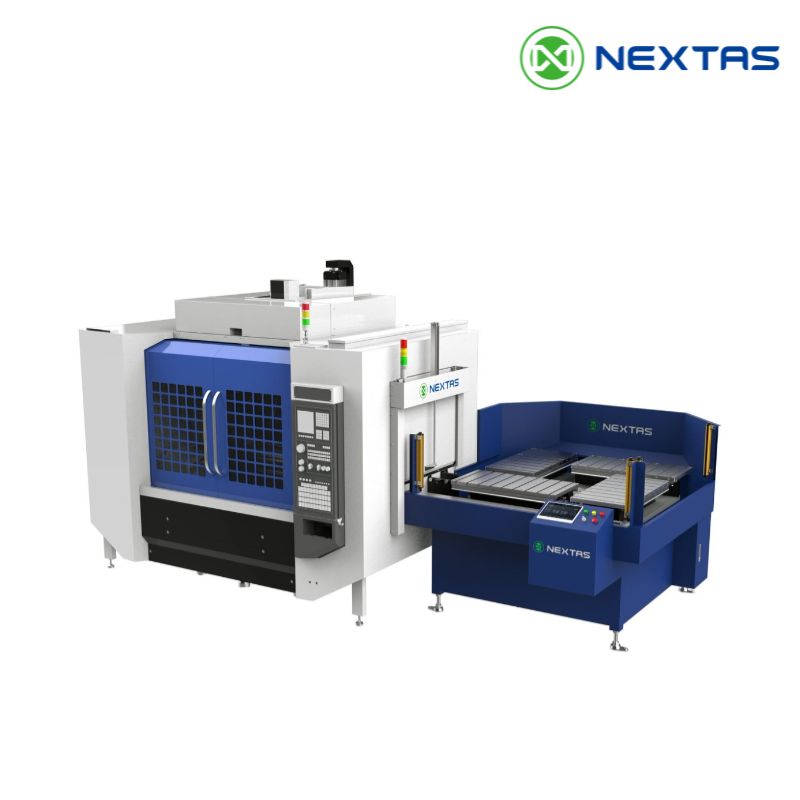
Automatic Pallet Changer
Integrate for fully automated production cycles and increased throughput.
View Details →
E-Series Chuck
High-precision pneumatic chuck for automated lathe and milling applications.
View Details →
R-Series Chuck
Robust chucking solution for heavy-duty turning and stationary clamping.
View Details →