
 English
 Español
 Français
 Deutsch
 Polski
 Türkçe
 Русский
 简体中文
简体中文

Enter your email address to request the brochure. Due to time zone differences, we’ll email it the next business morning (GMT+8, Beijing Time).
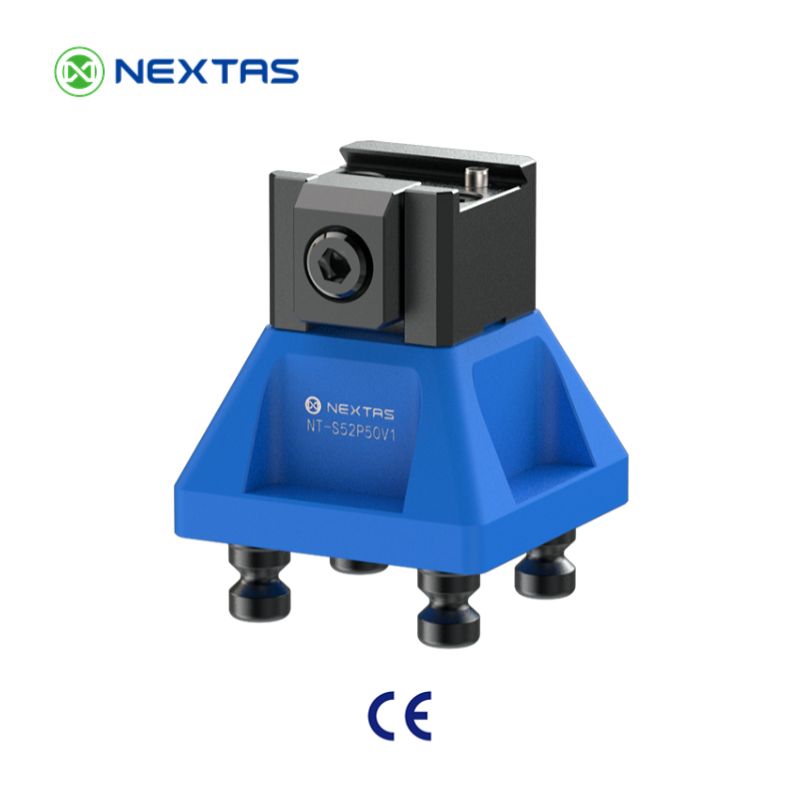
5-Side Machining Fixture
5-Axis Dovetail Fixture for 52 mm / 96 mm Quick-Change Systems
P50, 3-station, and P150 fixture layouts for five-side machining with a compact 45° dovetail grip.
The Nextas dovetail fixture family is built for shops that want more five-side access without committing a large amount of sacrificial stock. Choose between compact P50, denser three-station P50, and larger P150 layouts, then match the fixture to a 52 mm or 96 mm quick-change foundation for repeat jobs, pallet setups, and automation handoff.
45° dovetail clamping
52 mm + 96 mm interface path
Five-side access for 5-axis work
Best fit
Choose this route when spindle access matters more than full-body support
A strong fit for smaller blanks, repeat parts, and five-side machining where the shop wants minimal stock waste, easier tool access, and fast reuse on quick-change bases.
Compare first
Lock the interface family before comparing every model code
The faster selection path usually starts with 52 vs 96 system compatibility, pallet or zero-point usage, and whether the project needs single-part stiffness or higher fixture density.
Jump in by task
Start with the decision already on the table
Use the links below when the project is currently about model selection, zero-point integration, repeatability control, or resource review.
Selection focus
Choose between P50, three-station P50, and P150 by balancing part size, fixture density, machine footprint, and rigidity needs.
Integration focus
Check 52 mm vs 96 mm compatibility, zero-point plate linkage, pallet strategy, and how the fixture will move between machines or cells.
Process focus
Review dovetail prep depth, stock allowance, clamp access, and the repeatability checks that protect five-side machining quality.
Fast engineering handoff
Send the machine and stock strategy first
- Machine model, 5-axis clearance, and preferred interface family.
- Part size, material, and how much sacrificial stock is acceptable.
- Need for zero-point plates, pallets, or repeated job transfer.
- Target repeatability plus any automation or loading requirement.
Catalogue Model MatrixSelection & Zero-Point Integration5-Side Machining Best PracticesTroubleshooting & RepeatabilityDovetail Fixture Selection ChecklistSelection CheatsheetResources & Downloads
Technical Specifications
Both 52 mm and 96 mm dovetail fixtures conform to industry-standard zero-point mounting patterns. Detailed dimensional drawings are provided below for quick reference.
52 mm Version
96 mm Version
Catalogue Model Matrix
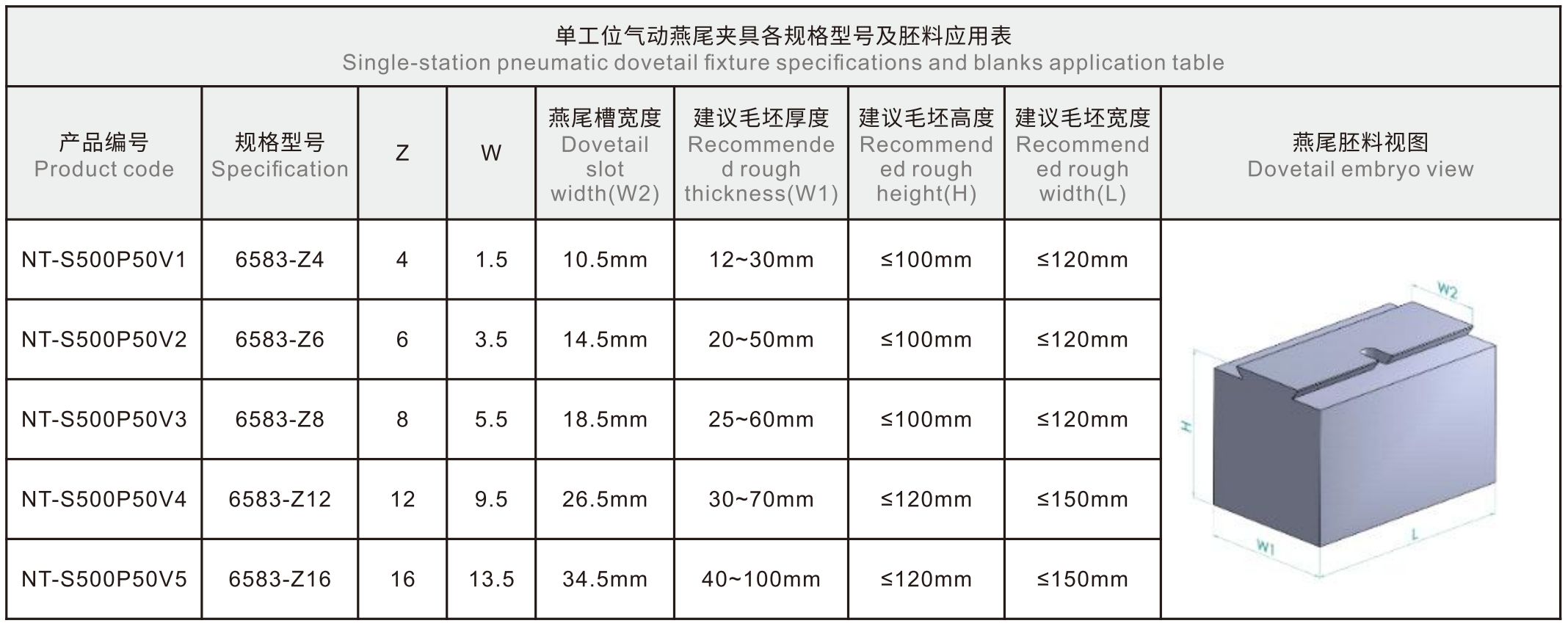
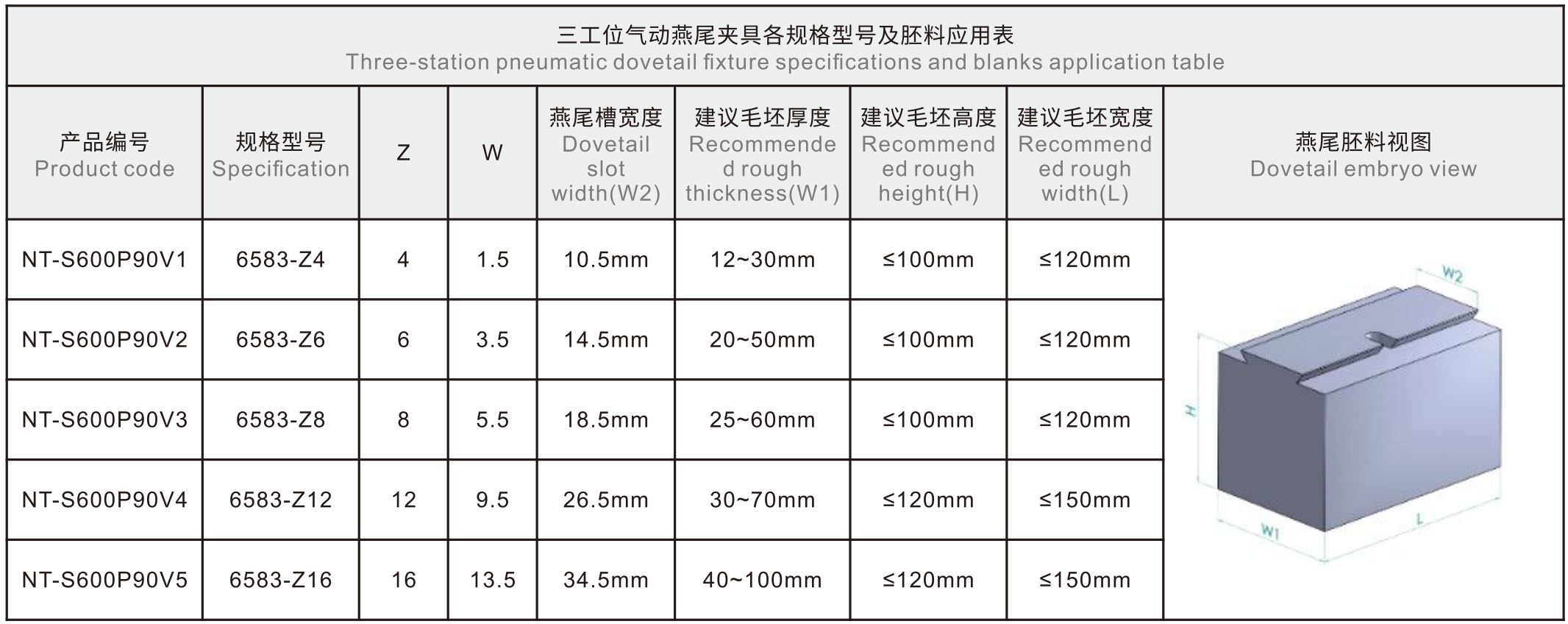
Nextas offers two pneumatic dovetail fixture families in the 2025 catalogue — the NT-S500P50 single-station series for compact parts and the NT-S600P90 three-station series for higher throughput. Both share a common 6583-Z dovetail-jaw platform, so operators can swap jaw widths across machines without re-learning the fixture.
| Product code | Dovetail jaw | Jaw width | Blank thickness | Blank length | Blank width |
|---|---|---|---|---|---|
| NT-S500P50 — Single-station pneumatic dovetail fixture · 4 kN clamping · <0.02 mm repeatability · hardened stainless steel · 6.5 kg | |||||
| NT-S500P50V1 | 6583-Z4 | 10.5 mm | 12–30 mm | ≤100 mm | ≤120 mm |
| NT-S500P50V2 | 6583-Z6 | 14.5 mm | 20–50 mm | ≤100 mm | ≤120 mm |
| NT-S500P50V3 | 6583-Z8 | 18.5 mm | 25–60 mm | ≤100 mm | ≤120 mm |
| NT-S500P50V4 | 6583-Z12 | 26.5 mm | 30–70 mm | ≤120 mm | ≤150 mm |
| NT-S500P50V5 | 6583-Z16 | 34.5 mm | 40–100 mm | ≤120 mm | ≤150 mm |
| NT-S600P90 — Three-station pneumatic dovetail fixture · >2.5 kN clamping · ≤30 kg load per station · hardened stainless steel · 6.5 kg | |||||
| NT-S600P90V1 | 6583-Z4 | 10.5 mm | 12–30 mm | ≤100 mm | ≤120 mm |
| NT-S600P90V2 | 6583-Z6 | 14.5 mm | 20–50 mm | ≤100 mm | ≤120 mm |
| NT-S600P90V3 | 6583-Z8 | 18.5 mm | 25–60 mm | ≤100 mm | ≤120 mm |
| NT-S600P90V4 | 6583-Z12 | 26.5 mm | 30–70 mm | ≤120 mm | ≤150 mm |
| NT-S600P90V5 | 6583-Z16 | 34.5 mm | 40–100 mm | ≤120 mm | ≤150 mm |
Choose NT-S500P50 when
You machine one blank per cycle, need the smallest pneumatic dovetail footprint on a compact table, or want a dedicated single-station fixture for short runs and prototypes.
Choose NT-S600P90 when
You want to run three identical or similar parts per cycle to maximize spindle uptime, reduce per-piece load/unload time, and raise throughput on a single machine table.
Dovetail jaw selection (6583-Z series)
The 6583-Z4 through Z16 jaws cover 10.5 mm to 34.5 mm dovetail widths. Select the jaw size based on blank thickness and desired clamping envelope — Z4/Z6 for thin plates, Z12/Z16 for thicker stock up to 100 mm.
Five-Side Machining Efficiency
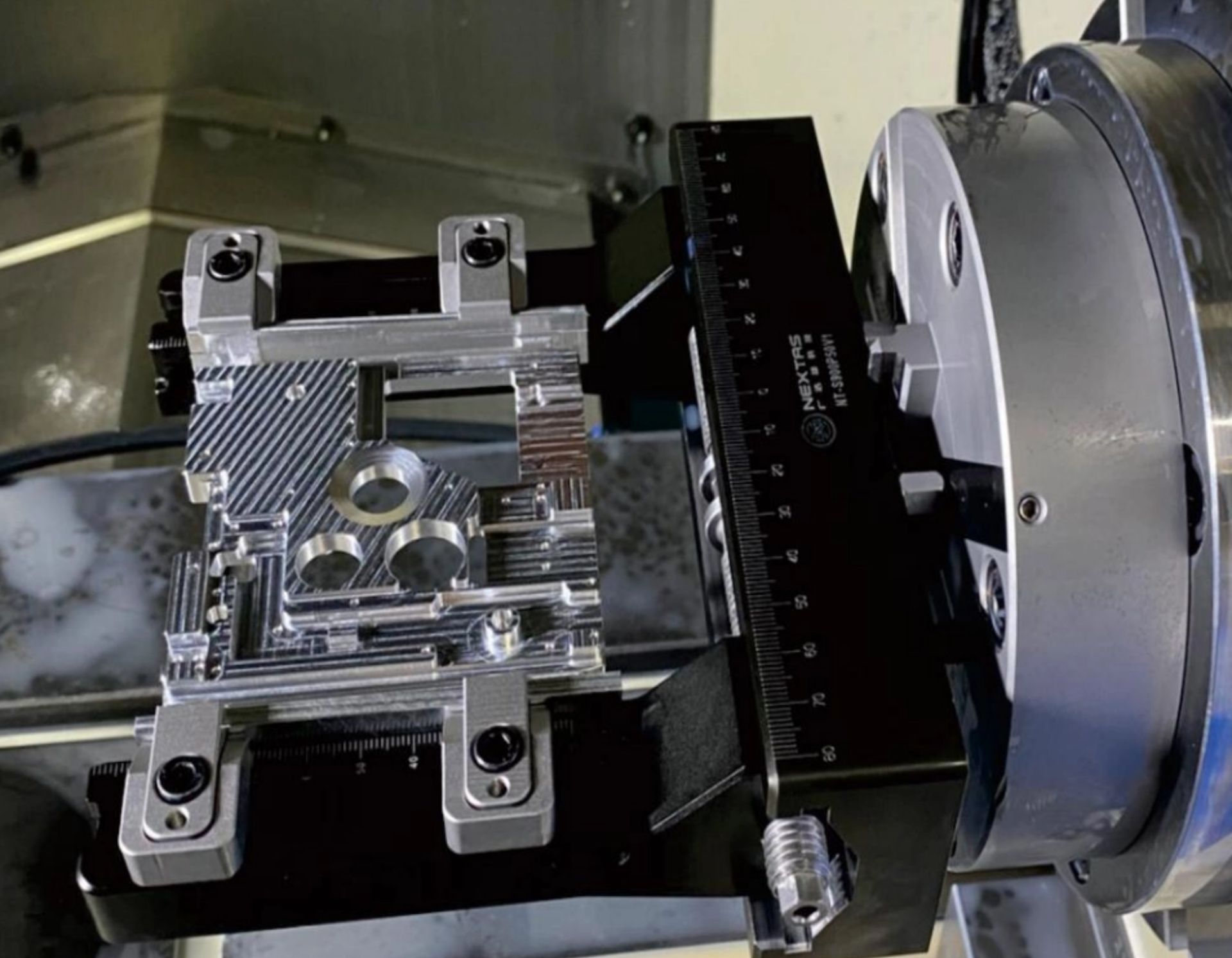
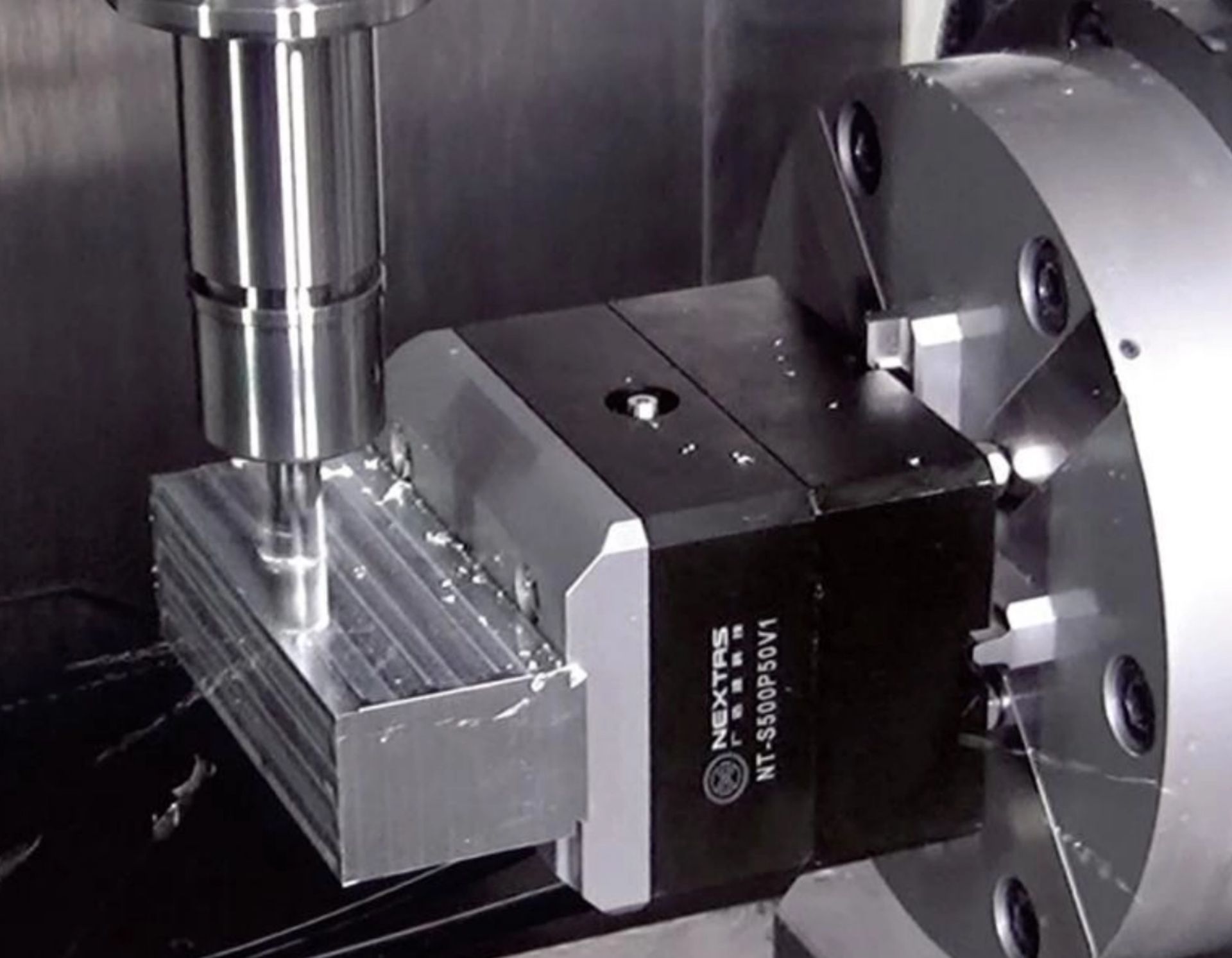
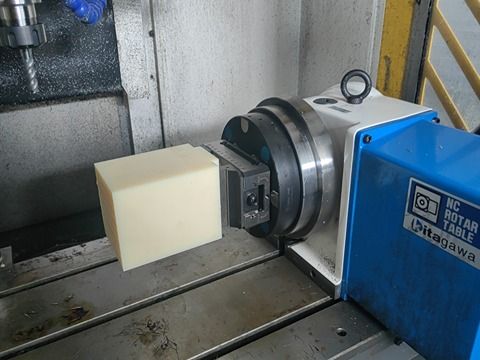
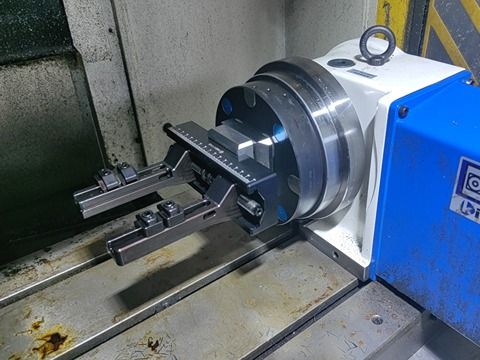
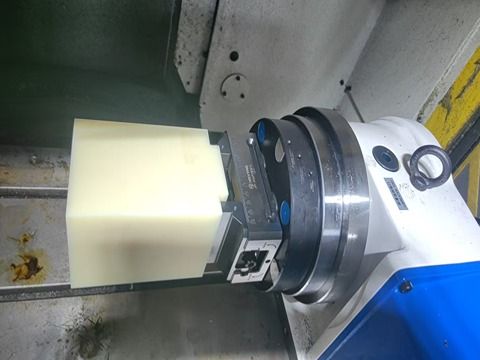
The dovetail fixture clamps the workpiece along a small 45° dovetail, leaving the top, front, back and two sides completely unobstructed for cutting. This design enables true five-side machining in a single setup and reduces the extra material normally required for gripping, saving both time and raw material costs.
Precision & Repeatability
Each dovetail fixture is fitted with precision locating pins and ground reference surfaces to eliminate slide and ensure high repeatability when swapping parts. Combined with the rigid dovetail geometry, this guarantees consistent machining accuracy and surface finish.
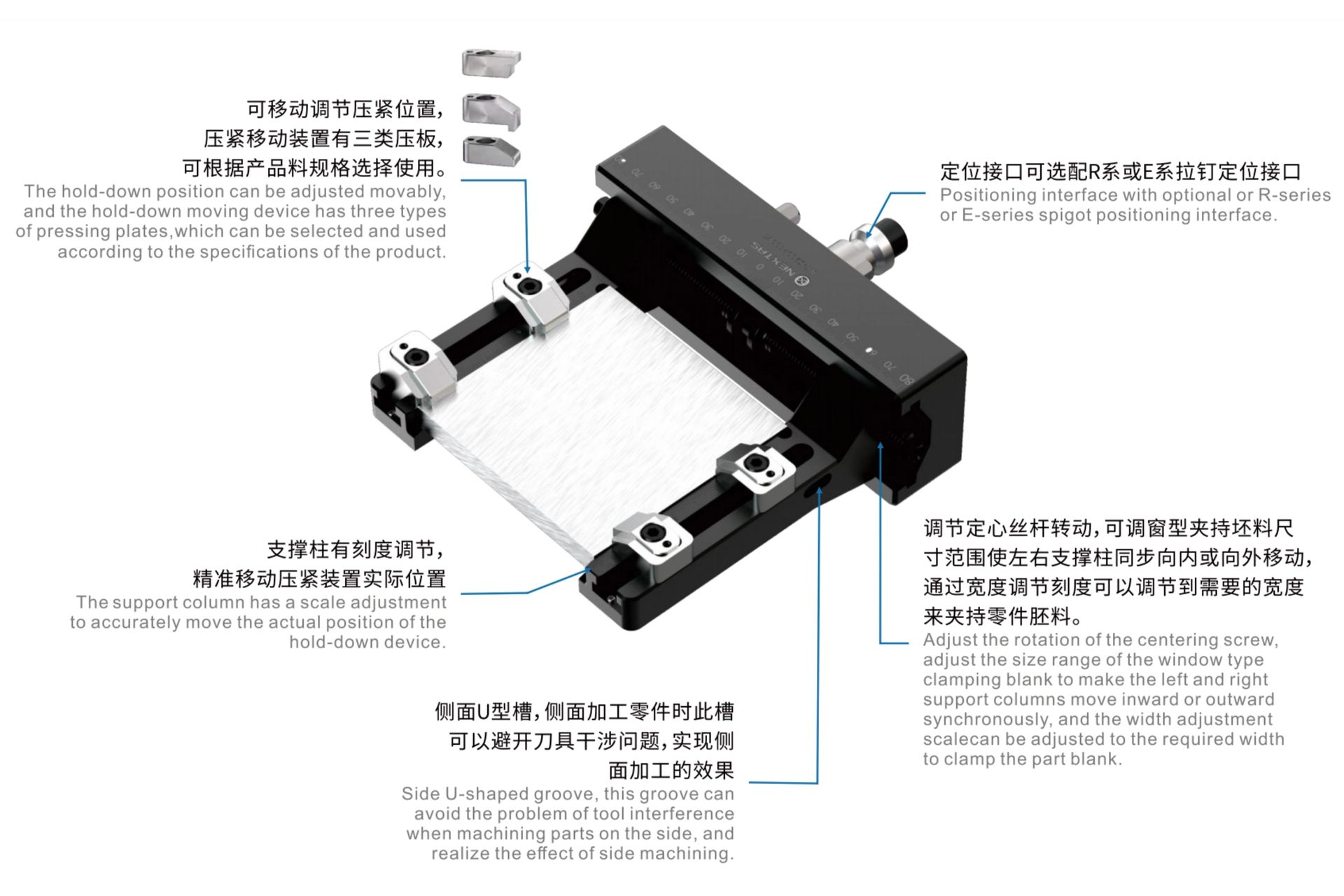
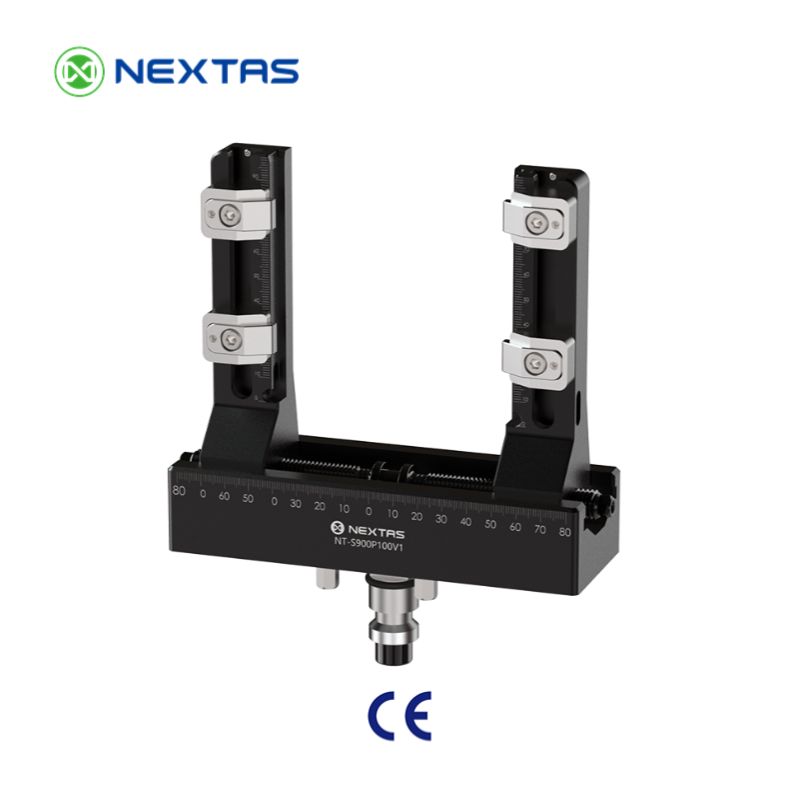
- Patented design for small plate processing on 3/4/5-axis machines.
- Adjustable clamping position with selectable pressing plates.
- Support column with scale adjustment for precise hold-down placement.
- Side U-shaped groove avoids tool interference during side machining.
- Optional 3R or Erowa spigot positioning interfaces.
Modular & Zero-Point Compatible
The base of the fixture is machined to industry-standard 52 mm and 96 mm patterns, making it directly compatible with zero-point clamping plates, quick-change systems and automation pallets. This modularity streamlines setup changes and allows multiple fixtures to be mounted in high-density arrays for increased throughput.
Applications & Use Cases
Case Study: Industrial Automation
The dovetail fixture works with the pneumatic zero-point plate, enabling fast, precise clamping of thin-sheet products in industrial automation. It cuts setup time and boosts efficiency by over 30%, keeping the part stable during the run.
Complex 5-Axis Machining
Ideal for titanium and aerospace parts requiring full-surface access. The dovetail fixture exposes five faces, allowing intricate features to be milled in one setup without repositioning.
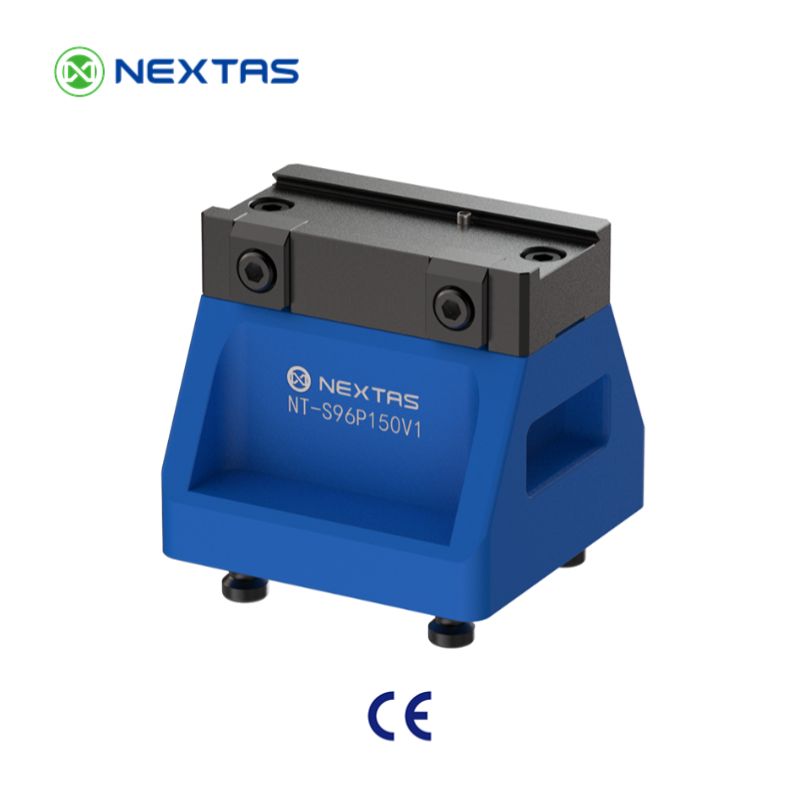
Quick Change & Automation
With standard 52 / 96 mm mounting patterns, fixtures drop into zero-point plates for lightning-fast swaps. Combine with robotic pallet changers for fully automated, high-density production lines.
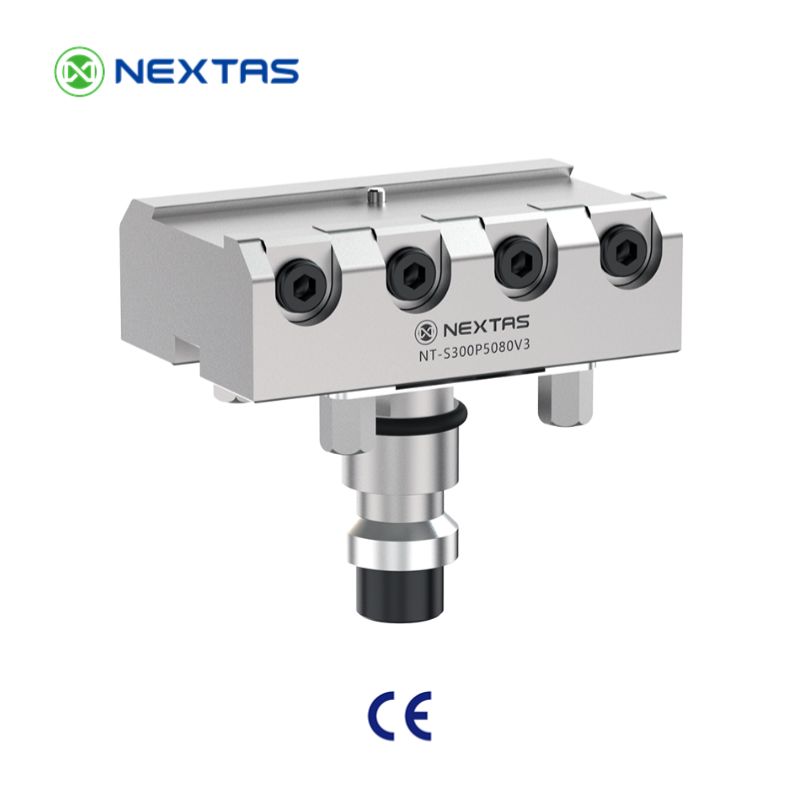
Material Versatility
From aluminium to hardened steel, the dovetail fixture securely holds a variety of materials. Its balanced design reduces distortion and makes it perfect for prototyping as well as series production.
Selection & Zero-Point Integration
Plan dovetail workholding like a system: fixture size, zero-point base, pallet/automation strategy, and chip/coolant flow all affect real-world repeatability.
System 52 vs System 96: quick decision table
Use this decision matrix when you’re choosing a 45° dovetail fixture for 5-axis machining and a zero-point clamping stack. It’s a fast way to align part size, cutting load, and automation needs.
| Consideration | System 52 | System 96 | What to verify |
|---|---|---|---|
| Part size & handling | Small to mid-size parts; higher station density on a compact plate. | Mid to larger parts; more base area for stable docking on pallets. | Machine envelope, pallet size, and how you load (manual/robot). |
| Cutting load & rigidity | Great for general milling and lighter roughing; optimize toolpaths to keep forces balanced. | Best when you need maximum stiffness for heavier roughing or tougher materials. | Stock removal rate, tool length, chatter risk. |
| Automation / palletization | Lower mass helps robots and quick swaps; ideal for high-mix cells. | More stable on larger pallets; preferred for lights-out cells with heavier parts. | Receiver/pallet compatibility and repeatability after swaps. |
| Chip & coolant clearance | Compact layouts can pack stations tightly—plan chip evacuation carefully. | More spacing options for shields, air blast, and chip evacuation. | Coolant direction, chip buildup risk, cleaning routine. |
| Typical use cases | Prototype → production, small housings, thin-wall/window-style parts, high-density arrays. | Larger brackets, tougher alloys, higher torque cuts, palletized production. | Target tolerance, surface finish, and cycle time goals. |
Tip: If you’re building a palletized cell, pair the fixture with a zero-point plate so stations can be exchanged without re-indicating.
When to choose System 52
Best for small to mid-size parts, tight machine envelopes, and high-density arrays. Great for quick prototype-to-production changeovers on 3-axis/4-axis/5-axis machines.
- High station density on a compact plate
- Fast swapping on System 52 zero-point receivers
- Lower mass for rapid robot handling
When to choose System 96
Use System 96 for heavier cuts, larger parts, or when you need maximum rigidity on pallets and automation cells.
- Wider base improves stability
- Pairs well with larger zero-point plates/pallets
- More room for stops, locators, and chip evacuation
Automation & palletization tips
For lights-out production, combine a dovetail fixture with a zero-point plate and pallet changer so stations can be exchanged without re-indicating.
- Combine with a pneumatic zero-point plate to eliminate re-indicating between setups
- Add an automatic pallet changer for unattended lights-out shifts
- Run multiple fixtures per pallet to keep the spindle cutting while setups happen off-machine
5-Side Machining Best Practices
A clean, consistent 45° dovetail is the difference between “it holds” and “it runs production.” These steps help you get stable clamping and predictable cycle times.
1. Machine a consistent 45° profile
Use a matching dovetail cutter and keep the depth consistent across batches. Deburr the profile so the fixture seats fully.
2. Control part distortion
Clamp close to stiff regions. For thin or window-style parts, use support columns/pressing plates to avoid bending.
3. Validate with a trial cut
Run a short rough+finish program, then check key datums. If needed, add stops/locators to prevent axial slip.
4. Keep interfaces clean
Chip contamination is the #1 enemy of repeatability—clean the dovetail and the zero-point interface before every swap.
Next step
Share your part size, material, and machine model. We’ll propose a proven 45° dovetail workholding setup (fixture size, station layout, and zero-point stack) to match your tolerance and takt time.
Troubleshooting & Repeatability
Even a great 45° dovetail fixture can lose repeatability if chips, distortion, or excessive tool load creep in. Use this quick table to diagnose the most common issues in 5-axis dovetail workholding and zero-point setups.
| Symptom | Likely cause | Recommended fix |
|---|---|---|
| Part slips during roughing | Dovetail profile inconsistent, clamp not seated, or cutting forces too aggressive. | Re-cut the 45° profile, deburr, and reduce tool engagement; add stops/locators if needed. |
| Chatter / vibration marks | Insufficient rigidity, long tool reach, or resonance at high RPM. | Switch to System 96 or reduce overhang; tune feeds/speeds; use shorter tools and balanced toolpaths. |
| Thin walls distort | Clamping near flexible regions or uneven support on window-style parts. | Clamp closer to stiff ribs; use support columns/pressing plates; verify distortion after a trial cut. |
| Z height shifts after swapping | Chips on the dovetail or on the zero-point interface; coolant film. | Clean both interfaces every swap; add air blast/brush at load station; keep receivers dry and protected. |
| Marks on the dovetail | Burrs, too much clamping pressure, or poor surface condition. | Deburr and add a small lead-in chamfer; use correct clamp force; consider sacrificial dovetail pads. |
| Repeatability degrades over time | Wear, contamination, or damaged locator pins. | Inspect pins and contact surfaces; replace worn inserts; schedule periodic cleaning and calibration checks. |
If you’re running lights-out production, pair this fixture with a pneumatic zero-point plate and pallet changer so docking is consistent across stations.
Dovetail Fixture Selection Checklist
Validate fit, rigidity, and automation readiness before you commit to a production workholding stack.
Part & process
- Material (aluminum / steel / titanium) and target removal rate
- Part geometry: thin wall, window style, or tall features
- Target tolerance and whether you want to avoid re-indicating
System compatibility
- System 52 vs System 96 decision based on load and density
- Zero-point base / pallet interface (receiver pattern, clearance)
- Automation plan: robot handling, pallet changer, queue length
Dovetail prep
- 45° dovetail depth and width (repeatable across batches)
- Deburring and seating check (no chips at contact faces)
- Stops/locators if heavy torque or aggressive side milling
Proof & support
- On-machine photos/videos showing tool clearance
- Inspection excerpt for multi-face positional results
- Spare parts plan for screws/pins and recommended maintenance
Selection Cheatsheet
A compact, shop-floor reference to help you choose the right configuration, integrate cleanly with your machine/automation, and keep repeatability stable in daily production.
1) Selection: pick the right configuration
| If you care most about… | Start with… | Why this helps |
|---|---|---|
| Fast changeovers / high-mix jobs | Standardize one interface (zero-point / ITS / 3R) across machines + build fixture plates/pallets. | Enables offline setup and swaps in seconds with minimal re-indicating. |
| 5-axis access and tool clearance | Choose low-profile components and plan clearance early (stack height, clamp body, wrench access). | Avoids collisions and preserves reach for deep features. |
| Lights-out / robot-tended machining | Add confirmations (clamp-OK / part-present), chip protection, and a recovery sequence. | Reduces mis-load risk and improves automation reliability. |
| Heavy roughing / high cutting forces | Increase support points and rigidity (more clamping stations, stiffer base, shorter stack-up). | Minimizes deflection and protects surface finish. |
2) Integration: what to prepare before install
| Item | Typical choice | Practical tip |
|---|---|---|
| Mounting and datums | Bolt pattern + dowel pins / keyways / reference edge | Define a master datum and keep a gauge pallet/part for quick verification. |
| Utilities | Clean, dry air with FRL; stable pressure; (hydraulic/electrical if used) | Drain FRL regularly and avoid long, restrictive hoses that slow actuation. |
| Control handshake | M-codes/PLC I/O: clamp, unclamp, clamp-OK, fault | Use timeouts + safe states; log signals to diagnose intermittent downtime. |
| Process validation | Probe macro / indicator check / first-article routine | Baseline repeatability after installation, then compare weekly. |
3) Maintenance: keep repeatability stable
| Risk / wear point | Early symptom | Prevention / quick fix |
|---|---|---|
| Chips on locating surfaces | Parts shift, repeatability drifts | Air-blow + wipe seating faces; add chip covers/air blast if needed. |
| Seals/wipers and sliding surfaces | Slow actuation, leaks, inconsistent clamp | Inspect on schedule; keep coolant/abrasives out; replace wear items proactively. |
| Loose fasteners / damaged contact faces | Unexpected misalignment, vibration marks | Torque-check; use dowels; stone minor nicks (don’t ‘machine’ the datum). |
| Contaminated air/oil | Sticky motion, alarms in automation | Improve filtration, dry air, drain bowls; keep a simple spare-kit. |
Need CAD/STEP, a mounting pattern, or a recommended setup for your part?
Contact usFrequently Asked Questions
How much material do I need to prepare for the 45° dovetail?
For optimal clamping, prepare a 45° dovetail on the raw stock with a depth of about 3–5 mm. This small engagement delivers strong pull-down holding while keeping five faces open for machining, reducing stock waste versus traditional vises.
What is the primary difference between the 52 mm and 96 mm dovetail fixtures?
It’s mainly the mounting pattern and scale. System 52 is great for smaller parts and high-density setups. System 96 offers a wider footprint and pairs with larger zero-point plates/pallets for heavier parts and maximum stability.
Can I use these dovetail fixtures on a 3-axis or 4-axis machine?
Yes. Even on 3-axis/4-axis machines, dovetail workholding improves rigidity and tool access, and it speeds up changeovers—especially for high-mix production.
What dovetail angle and cutter do you recommend?
The fixtures are designed around a 45° dovetail. Use a matching dovetail cutter sized to your stock and leave a clean, burr-free profile. If you’re unsure, share your part drawing and material and we’ll recommend a proven dovetail spec.
How does this dovetail fixture compare to a self-centering vise for 5-side machining?
A self-centering vise grips two parallel sides, which blocks tool access and needs taller stock. A dovetail fixture grips a small 45° profile at the base, creating pull-down clamping and leaving five faces unobstructed—ideal for true 5-side machining.
How do I prevent part pull-out or vibration during aggressive machining?
Keep overhang low, ensure the dovetail is consistent and deburred, and match fixture size to load (System 96 for heavier cuts). For high torque operations, add stops/locators where needed and validate the process with a trial cut and inspection.
Is it suitable for thin plates or window-style parts?
Yes. For thin or window-style parts, use the appropriate pressing plates/support columns and place the clamp point close to the stiffest area of the part to minimize distortion.
How repeatable is swapping parts when combined with a zero-point plate or pallet?
Repeatability depends on the zero-point base and your dovetail consistency. With clean interfaces, consistent dovetail prep, and proper seating, many shops can swap parts quickly with minimal touch-off—always verify to your tolerance requirements.
What kind of maintenance do these fixtures require?
Blow chips out of the clamping interface regularly, keep contact surfaces clean, and lightly lubricate threaded elements to prevent galling. Periodically check wear items (screws/pins) and replace as needed.
Are the clamping components and locating pins replaceable?
Yes. Wear components such as clamping screws and locating pins are field-replaceable, helping you maintain consistent performance over long service life.
Resources & Downloads
Related Products

E-Series Chuck
A versatile and precise chuck for a wide range of automated turning applications.
View Details →
R-Series Chuck
Provides powerful, consistent clamping for heavy-duty turning and milling operations.
View Details →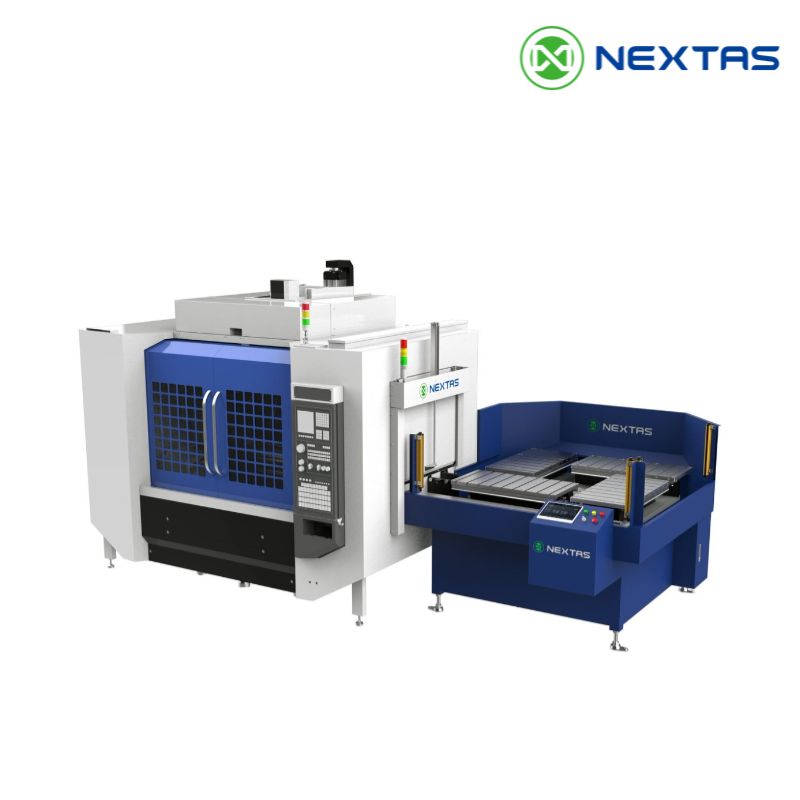
Automatic Pallet Changer
Drastically reduce setup time and increase machine uptime with fully automated pallet changes.
View Details →