Blog

How does a 5-axis self-centering vise improve CNC machining efficiency for complex workpieces?

Discover how 5-axis self-centering vises from NextasTech, featuring quick-change jaws and multi-station designs, dramatically improve CNC machining efficiency, precision, and throughput for complex workpieces in industries like aerospace and automotive.

Published on September 16, 2025 by NextasTech6 min read
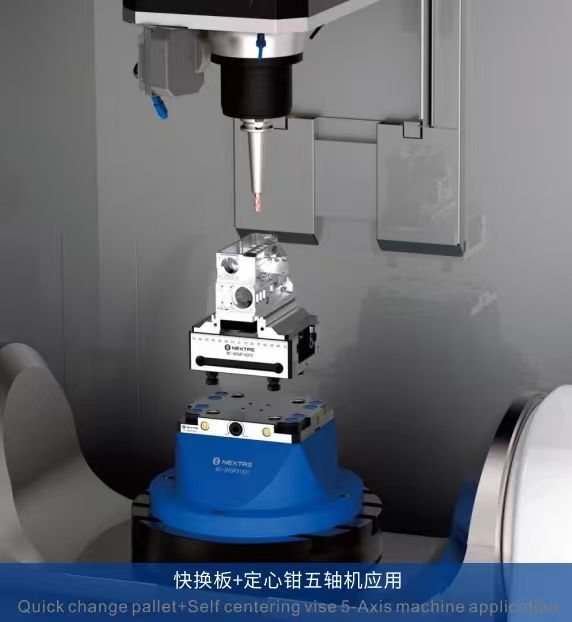
A NextasTech 5-axis self-centering vise securely holding a complex aerospace component inside a CNC machine, showcasing its precision.
The NextasTech 5-axis vise is engineered to maximize efficiency for complex part machining.

The 5-Axis Self-Centering Vise: Your Key to Precision for Complex Parts

In the world of high-precision CNC machining, especially for complex parts, the 5-axis self-centering vise is truly a "hidden guardian" and "golden partner". It is engineered for efficient and high-accuracy processing of intricate components. The core advantage lies in its "self-centering" capability: when clamped, the jaws automatically move towards the center, ensuring the workpiece's true center aligns perfectly with the machine spindle. This design can control the repeatability to within 0.01mm, with NextasTech's advanced systems achieving an impressive ±0.002mm. This makes them ideal for cylindrical or symmetrical parts like shafts, discs, or gear blanks, and they are widely used in 3-axis, 4-axis, and 5-axis CNC milling machines and machining centers.

Quick-Change Jaws: Unlocking Flexibility and Minimizing Downtime

In today's fast-paced manufacturing environment, rapid setup and flexibility are crucial for handling diverse complex workpieces. The quick-change jaw design of 5-axis self-centering vises is a game-changer.

A close-up shot of the quick-change jaw mechanism on a NextasTech 5-axis vise, showing its ease of use.
Lightning-fast jaw swaps dramatically reduce setup and changeover times.
  • Lightning-Fast Setup and Reduced Downtime: Our vises allow for incredibly quick installation and removal of jaws, often in mere seconds. This efficiency is further enhanced by the ability to rotate the jaws 180° to increase the clamping range. With advanced systems, this innovation can reduce CNC setup time by up to an impressive 90%, significantly boosting your machine's spindle hours.
  • Versatility for Diverse Workpieces: The quick-change design allows for easy switching between different jaw types. You can use standard serrated hard jaws for roughing or switch to machinable soft jaws for delicate finishing operations. This flexibility ensures that a wide range of workpiece sizes and shapes can be accommodated efficiently.
  • Maintaining Micron-Level Precision and Stability: Despite the speed of change, quick-change jaws are engineered to maintain consistent, micron-level repeatability. Our vises are designed for repeatable positioning accuracy within 0.005mm, with NextasTech guaranteeing an even tighter ±0.002mm.

Multi-Station Design: Maximizing Throughput and Machine Utilization

Optimizing the production process for complex workpieces often requires multi-station workholding solutions. This design approach fundamentally transforms how parts are machined, particularly in complex 5-axis operations, becoming a "super helper" for production lines.

A multi-station setup with several NextasTech vises on a single base plate inside a 5-axis CNC machine, processing multiple parts simultaneously.
Multi-station designs maximize machine utilization and overall throughput.
  • Consolidated Operations and Reduced Handling: Multi-station fixtures enable multiple workpieces to be clamped simultaneously. For example, you can arrange 3 to 4 vises on a single 400mm base, processing several parts in one go. This significantly reduces workpiece handling and re-clamping.
  • Enhanced Machine Utilization and Cost Savings: By minimizing idle time, multi-station setups drastically increase machine utilization, especially for high-value 5-axis machines. This directly translates into lower labor costs and improved operational efficiency.
  • Superior Accuracy and Adaptability: Reducing the number of clamping cycles inherently lowers the risk of cumulative errors, thereby improving overall processing accuracy. Moreover, these designs expand the capabilities of 5-axis machines for complex multi-face machining.
  • Seamless Integration with Automation: Modern multi-station systems are designed for seamless integration with automation, featuring ports for robotic loading and unloading and compatibility with zero-point systems like EROWA and System-3R.

The Holistic Impact on Your Complex Workpiece Production

The combined power of quick-change jaws and multi-station design in 5-axis self-centering vises from NextasTech profoundly impacts your production process. These innovations collaboratively solve common pain points such as "slow clamping, large errors, and difficult changeovers".

These capabilities are not just features; they are critical enablers for "time-saving production secrets", making our vises the "golden partners" for modern precision manufacturing. By integrating these advanced workholding solutions, you empower your enterprise to achieve greater value and maintain a leading edge in a rapidly evolving market.

Comparison, Selection & Cost Guide (Quick Tables)

Use the quick tables below to choose the right workholding setup for jobs like “How does a 5-axis self-centering vise improve CNC machining efficiency for complex workpieces?”. We focus on changeover time, repeatability, automation readiness, and total cost—so you can make a confident choice fast.

Quick comparison: common workholding options

OptionBest forStrengthsWatch-outsTypical changeover
Zero-point system / zero-point clamping plateFrequent part changes, multi-part families, modular setupsFast repeatable locating, scalable, automation-readyNeeds clean interfaces; plan for chip control30–120 sec
Pneumatic viseHigh mix + unattended runs where cycle time mattersStable clamping force, easy automation, consistent loadingAir quality + pressure stability; safety interlocks1–3 min
Precision vise + Zero Point Clamping SystemGeneral CNC work where repeatable setups matterGood rigidity + faster swaps when standardizedVerify height/clearance; keep interfaces clean1–5 min
Self-centering viseSymmetric parts, 5-axis access, quick centeringCenters fast, reduces setup errors, good for 5-axisJaw travel limits; verify part envelope1–5 min
Hydraulic fixtureHigh-volume or high-clamp-force machiningStrong & stable, great for tight tolerancesHigher upfront cost; maintenance & leak checks5–20 min
Custom dedicated fixture / jigOne part, very stable process, repeat productionMax stability, lowest unit cost at scaleSlow to change; redesign needed for new parts10–60 min
Pallet changerParallel setup + spindle utilization gainsSetup off-machine, better OEE, easier lights-outNeeds process discipline + pallet standardsVaries (2–10 min off-machine)
FMS / pallet pool (automation)Many SKUs + long unattended windowsBest throughput + scheduling flexibilityHighest system complexity; needs planningN/A (system-level)

Fast selection: match your scenario

Your scenarioRecommended setupNotes
Many small batches; want faster setupsPrecision vise + zero‑point base/palletStandardize vise height and stop positions; reduce touching-off.
1–10 pcs, frequent changeovers, < 0.02 mm targetsZero-point system + modular baseBuild a “standardized base” and swap top tooling.
10–200 pcs, operator present, mixed geometriesSelf-centering vise or pneumatic vise + soft jawsAdd quick jaw change + pre-set stops.
200+ pcs, high clamp force, stable part familyHydraulic fixture or dedicated fixtureOptimize for cycle time + tool access.
Lights-out / unmanned shift (2–8+ hours)Pneumatic vise + pallet changer or FMSPrioritize sensing, chip evacuation, and fail-safe clamping.

What affects price (and how to control it)

Cost driverWhy it changes priceHow to reduce cost
Extra base plates / palletsStandard bases reduce setup time but add hardware costShare bases across vises; start with 2–3 pallets.
Repeatability requirement (e.g., ≤0.01 mm)Tighter repeatability needs higher precision interfaces and QCStandardize datums; use proven modules; avoid over-spec.
Changeover frequencyMore swaps reward quick-change systems (ROI grows fast)Measure setup time; prioritize the biggest bottleneck.
Automation level (sensors, interlocks, palletization)Adds hardware + integration timeStart with one cell; reuse components across machines.
Workpiece size & materialLarge/heavy parts need stronger clamping + bigger basesUse modular plates; right-size the fixture footprint.
Engineering time (custom vs modular)Custom design drives NRE costPrefer modular stacks; keep custom parts minimal.

Common mistakes (and quick fixes)

MistakeSymptomFix
Different setups on every jobLong setup time; inconsistent resultsCreate a standard base + checklist.
No collision checkTool limits or crashesSimulate, use shorter tooling, verify clamps.
Skipping chip control on locating surfacesRepeatability drifts; “mystery” setup errorsAdd air blast, covers, and a cleaning routine.
Over-clamping thin partsWarping, chatter, tolerance issuesUse proper jaw support + controlled clamping force.
No standard datum / pallet standardEvery setup becomes a one-offDefine a shop standard (datums, pallet, bolt pattern).
Choosing by lowest price onlyHigher labor cost + downtimeEvaluate total cost: labor, scrap, changeover time.

Want a recommendation for your parts? Send us your machine model, material, and tolerance target — we’ll suggest a practical setup.

Frequently Asked Questions

What is the main benefit of a "self-centering" vise in 5-axis machining?

The primary benefit is guaranteed precision. The vise automatically centers the workpiece on the machine's point of rotation, regardless of the part's size. This is critical for 5-axis operations where the part is rotated, ensuring features machined on different sides are perfectly aligned. It eliminates the need for manual centering, drastically cutting setup time.

How do quick-change jaws handle different part sizes without losing precision?

Our quick-change jaws are built on a high-precision base system. When swapped, they locate against hardened, precision-ground surfaces, ensuring repeatability within microns (e.g., ±0.002mm). This means you can switch from clamping a large raw block to a smaller, delicate part in seconds, and the vise maintains its center-line accuracy every time.

Can a multi-station vise setup be used for parts of different shapes in one cycle?

Yes, that's a key advantage. You can configure a multi-station base plate with different vises or jaw types. For example, one station could hold a raw casting with serrated jaws for roughing (Op 10), while a second station holds a semi-finished part in soft jaws for finishing (Op 20). This allows for multiple, varied operations in a single machine cycle, maximizing spindle uptime.

Is a 5-axis vise suitable for high-vibration tasks like roughing titanium?

Absolutely. Our 5-axis vises are designed for extreme rigidity. They use a robust mechanical clamping mechanism that provides high clamping force and dampens vibration. When combined with features like serrated or dovetail jaws, they offer aggressive, secure gripping, making them ideal for heavy roughing cuts even in tough materials like titanium or Inconel.

How does this type of vise integrate with a zero-point clamping system?

They are designed to work together perfectly. The 5-axis vise is typically mounted onto a base plate, which then mounts directly to the machine table via a zero-point system (like our NextasTech zero-point plates). This allows you to swap the *entire vise setup* in seconds with guaranteed ±0.002mm repeatability, further reducing setup time for completely different jobs.

Ready to Supercharge Your Machining?

At NextasTech, we are committed to providing you with cutting-edge solutions that optimize your manufacturing workflow. Discover how our precision 5-axis self-centering vises can transform your production line.

Contact our experts today —
Request a Technical Consultation →