English
 Español
 Français
 Deutsch
 Polski
 Türkçe
 Русский
 简体中文
简体中文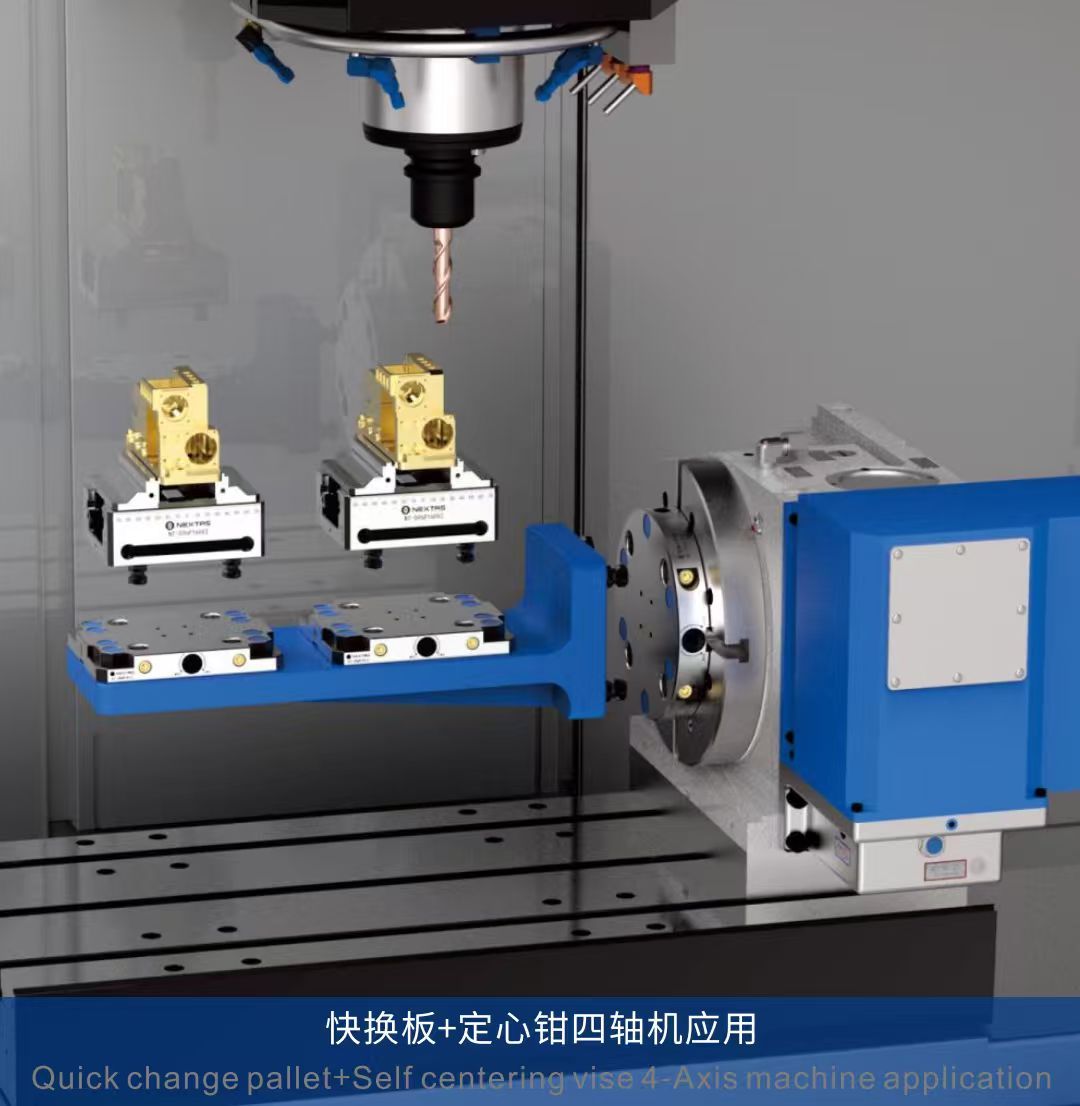
Most shops think about ROI only in terms of spindle uptime, but a self-centering vise often pays back in the minutes around the cut: jaw changes, manual indicating, first-part verification, and the hidden time operators spend making the setup feel “safe enough” before cycle start. Those minutes are easy to overlook because they are scattered throughout the day, yet they are exactly where workholding upgrades create measurable gains.
The real question is not whether a self-centering vise is more advanced than a conventional vise. The better question is: does it remove repeatable waste from your current workflow? If the answer is yes, ROI is usually easier to justify than shops expect.
Where Traditional Setups Lose Time
Traditional setups lose time whenever operators must re-establish the centerline from scratch. That may include jaw resets, stock indicating, re-touching offsets, and verifying whether the workpiece is centered well enough to proceed. On repeat jobs, none of that adds value for the customer—it is simply the cost of restoring a condition that should already be controlled by the workholding system.
There is also a quality cost. When two operators rebuild the same setup slightly differently, the first-part correction can move, the amount of stock left for finishing can vary, and the shop starts compensating with extra checks. In that situation, “more careful setup” is not a scalable answer. Better repeatability is.
What a Self-Centering Vise Changes in Daily Production
A self-centering vise improves the process because both jaws move symmetrically toward the workpiece. That creates a more predictable centerline return and reduces dependence on operator technique. In the Nextas catalogue, the self-centering vise family is described with repeat positioning accuracy below 0.02 mm, hardened stainless steel construction, and model families built around 52 mm and 96 mm spigot spacing—details that matter when shops want repeatable setups across different machine sizes.
In practical terms, the workflow becomes simpler:
- The part datum is easier to reproduce across batches.
- Jaw changes and clamping range adjustments become more standardized.
- Compact and larger workpieces can be matched to the right vise size without changing the entire setup philosophy.
- Operators spend less time proving the setup and more time running parts.

When Pairing with a Zero-Point System Delivers the Fastest ROI
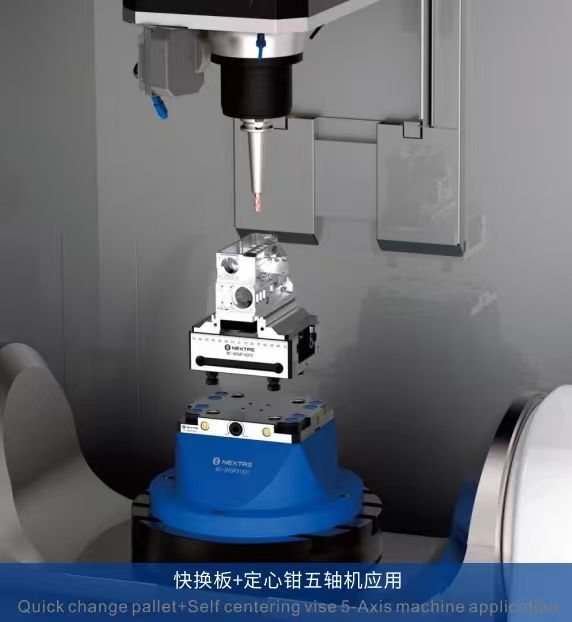
The fastest payback usually appears when the vise is not treated as a standalone component, but as part of a repeatable module. If a shop already removes vises between jobs, preloads parts offline, or wants to move proven setups from one machine to another, pairing the self-centering vise with a zero-point clamping plate changes the economics.
Instead of re-indicating every time, the whole vise-and-part package can return to a known machine position. That reduces non-cutting time, simplifies operator training, and creates a foundation for later automation. This matters even more in high-mix / low-volume production, where changeover frequency—not raw cycle time—is often the real capacity limiter.
| Scenario | Typical pain point | Why zero-point pairing helps |
|---|---|---|
| Repeat family jobs | Offsets and centering rebuilt too often | Returns the whole workholding package to the same machine reference faster. |
| Multi-machine production | Setup logic differs by machine or operator | Standard interfaces make transfer and training easier. |
| Automation roadmap | Manual clamping remains the bottleneck | Creates a modular base for robotic loading or unattended operation. |
Best-Fit Machines, Part Families, and Upgrade Paths
Not every shop needs the same self-centering vise size or workflow. Smaller 52 mm interface models often make sense for compact parts, lighter setups, and dense fixture layouts. Larger 96 mm interface models are better suited for bigger parts, higher clamping force, and more demanding production environments. The Nextas catalogue lists 14,000 N clamping force for the 52-series and 20,000 N for the 96-series, which is useful when comparing whether your current bottleneck is grip, rigidity, or simply changeover efficiency.
Shops usually get the best result by matching the upgrade path to the real production constraint:
- 3-axis shops often win first on setup repeatability and operator consistency.
- 4-axis and 5-axis users gain more from accessibility, repeatable centering, and modular transfer between fixtures.
- High-mix production gets the biggest payoff from standardizing the base interface early.

How to Estimate ROI Before You Buy
A useful ROI estimate does not need to be complicated. Start with four numbers:
- Average setup/changeover time per job
- How many changeovers happen per week
- Hourly machine cost plus setup labor cost
- How much first-part proving time is tied to centering and jaw reset work
Then compare your current method against a workflow where centering is standardized and the vise can return to a repeatable position. Even small reductions add up quickly. Saving 10–15 minutes on repeat changeovers across several machines can recover many hours per month without touching cycle time at all. And when scrap, rework, and easier operator handover are included, the case often becomes stronger than a pure labor calculation suggests.
If you are quoting a new project or reviewing an upgrade, send the machine model, material, blank size range, and expected changeover frequency. That is usually enough to judge whether a self-centering vise alone is the right move, or whether a self-centering vise plus zero-point system will pay back faster.