English
 Español
 Français
 Deutsch
 Polski
 Türkçe
 Русский
 简体中文
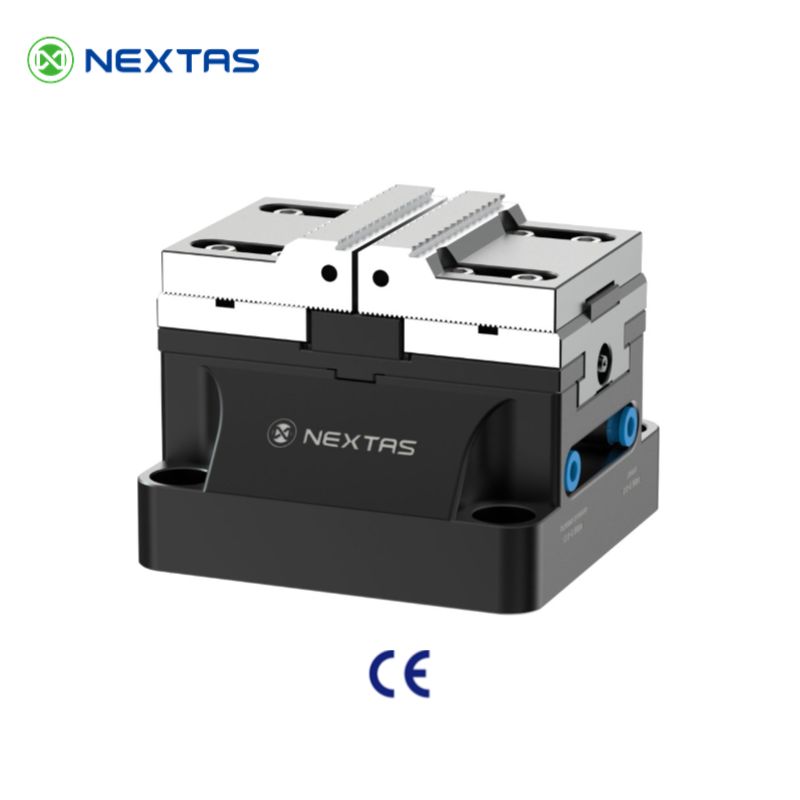
简体中文At Nextas, our experienced design team is the backbone of every custom solution. With deep industry insights spanning aerospace, automotive, and medical device manufacturing, we design and deliver custom fixtures that address your unique production challenges. Below are the core strengths of our custom-made pneumatic fixtures, built to improve precision, efficiency, and scalability in your operations.
1. Customized Adaptation for Multi-Industry Complex Workpieces
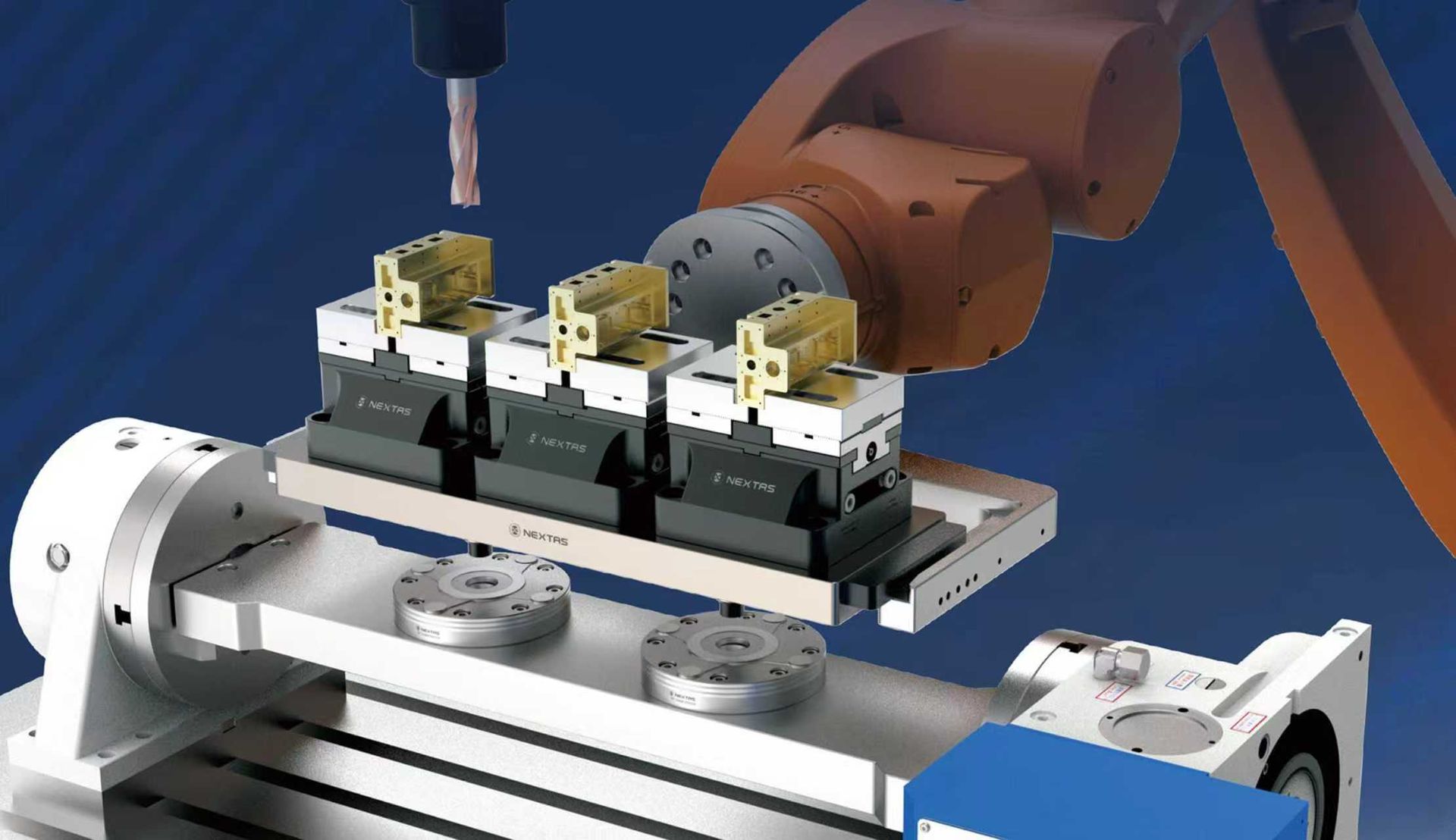
We specialize in tailor-made designs based on your workpiece’s exact size and shape, maintaining a perfect fit for even the most complex components. If you’re machining asymmetrical aerospace parts, high-tolerance medical devices, or rugged automotive components, our team works closely with you to understand every detail of your application. We eliminate the inefficiencies of ill-fitting standard fixtures, creating solutions that integrate well with your CNC machines and adapt to your unique processing needs—no compromises required.
2. High-Precision Performance for Stable Machining
Precision is embedded in every component of our pneumatic fixtures. Core parts are forged from high-hardenability alloy steel and treated with our proprietary heat process, achieving a surface hardness of HRC 58-62 for exceptional wear resistance and long-term stability. Paired with a repeat positioning accuracy of ±0.002 mm, this solid construction guarantees consistent, reliable performance across batches—even in the most demanding production environments. You can trust our fixtures to maintain micron-level precision, no matter how complex your workpiece.
3. Powerful Clamping Force for Superior Surface Quality
Equipped with a patented locking mechanism, our custom fixtures deliver over 25,000N of clamping force—enough to eliminate micro-vibrations during machining. This powerful yet controlled grip prevents workpiece deformation, maintaining immaculate surface finishes that meet the strictest quality standards. Unlike generic fixtures that risk slippage or uneven pressure, our tailored designs distribute force optimally across your workpiece’s unique contours, balancing strength with care to preserve part integrity while maximizing machining precision.
4. Efficient & User-Friendly Operation
Pneumatic actuation enables lightning-fast locking and unclamping, slashing workpiece changeover times and keeping your production line running smoothly. The integrated air-blast self-cleaning function is a major benefit: during each unclamping cycle, high-pressure air clears chips, coolant, and debris from mating surfaces, eliminating manual cleaning and preventing contamination. These features transform downtime into productive time, helping you boost throughput without sacrificing quality.
5. Easy Compatibility with Smart Manufacturing
Built for the future of production, our custom pneumatic fixtures feature integrated sensor feedback ports that enable easy integration with robotic loading/unloading systems and fully automated production cells. If you’re upgrading an existing line or building a new smart factory, our fixtures sync safely and efficiently with your automation ecosystem. This compatibility reduces human intervention, streamlines workflows, and lets you scale your manufacturing capabilities with confidence.
Final Thoughts: Expertise You Can Trust
Behind every fixture is Nextas’ 16-year legacy of excellence in industrial workholding solutions. Our production facilities are equipped with world-class precision machining tools from Hardinge (USA), Okuma (Japan), and more, and we hold ISO 9001, ISO 14001, and ISO 45001 certifications—guaranteeing reliability, quality, and compliance in every custom solution.
Don’t let standard fixtures limit your potential. If you need a fixture for a one-of-a-kind prototype or high-volume production of complex parts, Nextas Custom-Made Pneumatic Fixtures are engineered to adapt to your workpiece’s shape and dimensions, with the precision, power, and efficiency your operations demand.
What speeds up a custom fixture review
Custom workholding projects move faster when the engineering team receives the real manufacturing constraints up front instead of only a part drawing. In addition to the 3D model or sample part, it helps to share datum strategy, machining sequence, material condition, required access for tools and probes, cosmetic surfaces that cannot be marked, and the target loading method. Those details often determine whether the fixture should prioritize rigidity, clearance, self-centering behavior, anti-lift support, or sensor feedback.
- Part drawing or 3D file, plus the surfaces that matter most for tolerance control.
- Machine type, axis configuration, spindle orientation, and coolant/chip environment.
- Annual or monthly volume, batch pattern, and whether robot loading is planned.
- Changeover target, allowable operator steps, and preferred clamp confirmation method.
A practical custom fixture workflow
For most projects, the safest path is concept review first, then clamping simulation, then prototype verification on the actual machine or a comparable test environment. That sequence catches the problems that are easiest to miss on paper: tool interference, chip build-up around seats, unstable support points, and operator handling friction. When those issues are solved early, the final fixture is easier to maintain and much easier to duplicate across multiple machines.
A well-designed pneumatic fixture should not only hold the part securely; it should also reduce operator variability, shorten workpiece exchange, and give the process a repeatable foundation that production can trust for months or years.