Blog

NextasTech 4-Fold Quick•Point Plate: Your Top Choice for High-Precision Zero-Point Clamping

Discover why the NextasTech 4-Fold Quick•Point Plate is the benchmark for zero-point clamping. Featuring 4-position synchronous clamping, 5-micron precision, and universal compatibility for aerospace and medical machining.

Published on January 8, 20264 min read
Table of contents

Need help with workholding?

Tell us your machine type, material, and tolerance target — we’ll recommend the best setup.

Request a Technical Consultation →
Featured

See also: Zero-Point Clamping Systems

Watch: NextasTech precision clamping in action (YouTube Short)
Watch: Additional NextasTech demonstration

The NextasTech 4-Fold Quick•Point Plate, with its innovative 4-position clamping design and excellent performance indicators, stands out in the fiercely competitive market. It has become the preferred choice for manufacturers pursuing high-precision zero-point clamping. This article conducts a systematic analysis from four core dimensions, clarifying why NextasTech is the new benchmark in the field.

1. Core Pain Points in High-Precision Machining Clamping

With the continuous improvement of product precision requirements and the popularity of small-batch, multi-variety production, traditional clamping methods are increasingly unable to meet modern needs. Several pain points have become prominent:

  • Low Efficiency of Manual Clamping: Traditional setups require repeated debugging and calibration (20-60 minutes per setup), resulting in equipment utilization rates often below 60%.
  • Unstable Positioning Accuracy: Manual operation leads to human errors and accumulated positioning deviations. For aerospace or medical parts, a deviation of even 0.01mm can result in scrapped workpieces.
  • Poor Compatibility: Customized fixtures for specific machines lack the flexibility needed for diverse production lines.
  • High Maintenance Costs: Complex designs and rapid wear of components increase operational costs and extend downtime.

2. Core Advantages of NextasTech 4-Fold Quick•Point Plate

Addressing these pain points, NextasTech has achieved comprehensive upgrades in technology and design:

2.1 4-Position Synchronous Clamping

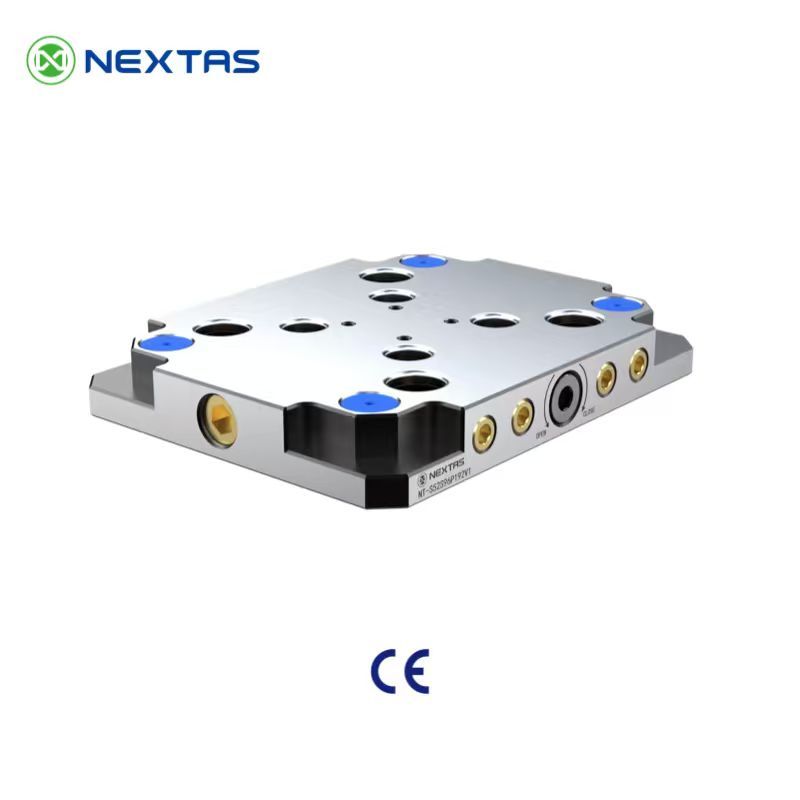
The innovative 4-position integrated clamping design integrates four independent high-precision modules. Unlike single or dual-position plates, it realizes synchronous locking, ensuring uniform force application to avoid deformation.

Impact: Setup time is reduced to just 2-3 minutes—80% faster than traditional methods. This efficiency leap increases equipment utilization to more than 85%.

2.2 Ultra-High Precision Index

Precision is our core competitiveness. The plate uses high-hardness alloy positioning pins and precision-ground components to achieve a repeat positioning accuracy of ≤0.002mm.

For example, in manufacturing precision gears for new energy vehicles, using our plate reduced tooth profile deviation by 40% and surface roughness by 35%. With a clamping force of up to 25kN, it effectively suppresses vibration during high-speed cutting.

2.3 Universal Compatibility

The standardized interface design is fully compatible with mainstream 5-axis machining centers, horizontal/vertical centers, and rotary tables. Manufacturers can expand clamping modules to adapt to workpieces from 50mm to 3000mm. The modular design also allows wearing parts to be replaced in under 10 minutes.

2.4 Durable and Reliable Design

Constructed from high-strength alloy with excellent wear and corrosion resistance, the plate maintains precision within 0.001mm even after 100,000 clamping cycles. Its fully sealed protection structure prevents coolant and chips from entering internal components. Additionally, the intelligent energy-saving design consumes only 3.5W of standby power—60% lower than similar products.

3. Industry Application Cases

The practical value of the NextasTech 4-Fold Quick•Point Plate has been verified in demanding scenarios:

Case 1: Aerospace Titanium Alloy Parts

A manufacturer of titanium engine blades struggled with low efficiency. After adopting NextasTech, setup time dropped from 45 minutes to 2.5 minutes. Production efficiency increased by 220%, and scrap rates fell from 4.2% to 0.6%, saving over $300,000 annually.

Case 2: Precision Medical Implants

For a medical device manufacturer, surface quality is paramount. Using our plate increased the one-time qualification rate of hip joint implants from 88% to 99.2%, while shortening the processing cycle by 35%. The stable clamping prevented deformation, ensuring clinical safety.

4. Why Choose NextasTech?

Compared to competitors, NextasTech offers superior cost-effectiveness. While the initial investment reflects the high quality, the long service life (3x ordinary plates), low maintenance, and energy savings typically yield an ROI within 8-12 months.

Furthermore, we provide a 3-year warranty and 7×24-hour remote technical support, ensuring your operations never stop.


Comparison, Selection & Cost Guide (Quick Tables)

Use the quick tables below to choose the right workholding setup for jobs like “NextasTech 4-Fold Quick•Point Plate: Your Top Choice for High-Precision Zero-Point Clamping”. We focus on changeover time, repeatability, automation readiness, and total cost—so you can make a confident choice fast.

Quick comparison: common workholding options

OptionBest forStrengthsWatch-outsTypical changeover
Zero-point system / zero-point clamping plateFrequent part changes, multi-part families, modular setupsFast repeatable locating, scalable, automation-readyNeeds clean interfaces; plan for chip control30–120 sec
Zero Point Clamping Plate + pallet standardsHigh repeatability + fast swaps on fixtures/palletsStable datum, scalable modularity, automation‑readyCleanliness + stud compatibility; plan chip control20–60 sec
Pneumatic viseHigh mix + unattended runs where cycle time mattersStable clamping force, easy automation, consistent loadingAir quality + pressure stability; safety interlocks1–3 min
Self-centering viseSymmetric parts, 5-axis access, quick centeringCenters fast, reduces setup errors, good for 5-axisJaw travel limits; verify part envelope1–5 min
Hydraulic fixtureHigh-volume or high-clamp-force machiningStrong & stable, great for tight tolerancesHigher upfront cost; maintenance & leak checks5–20 min
Custom dedicated fixture / jigOne part, very stable process, repeat productionMax stability, lowest unit cost at scaleSlow to change; redesign needed for new parts10–60 min
Pallet changerParallel setup + spindle utilization gainsSetup off-machine, better OEE, easier lights-outNeeds process discipline + pallet standardsVaries (2–10 min off-machine)
FMS / pallet pool (automation)Many SKUs + long unattended windowsBest throughput + scheduling flexibilityHighest system complexity; needs planningN/A (system-level)

Fast selection: match your scenario

Your scenarioRecommended setupNotes
High‑mix work; target repeatability ≤0.01 mmZero Point Clamping System + standard pallet/stud kitDefine a master datum; add chip covers; get a layout for layout help.
1–10 pcs, frequent changeovers, < 0.02 mm targetsZero-point system + modular baseBuild a “standardized base” and swap top tooling.
10–200 pcs, operator present, mixed geometriesSelf-centering vise or pneumatic vise + soft jawsAdd quick jaw change + pre-set stops.
200+ pcs, high clamp force, stable part familyHydraulic fixture or dedicated fixtureOptimize for cycle time + tool access.
Lights-out / unmanned shift (2–8+ hours)Pneumatic vise + pallet changer or FMSPrioritize sensing, chip evacuation, and fail-safe clamping.

What affects price (and how to control it)

Cost driverWhy it changes priceHow to reduce cost
Pallet/stud standardizationMore pallets/studs costs more upfront but saves changeover timePhase in pallets; reuse patterns across machines.
Repeatability requirement (e.g., ≤0.01 mm)Tighter repeatability needs higher precision interfaces and QCStandardize datums; use proven modules; avoid over-spec.
Changeover frequencyMore swaps reward quick-change systems (ROI grows fast)Measure setup time; prioritize the biggest bottleneck.
Automation level (sensors, interlocks, palletization)Adds hardware + integration timeStart with one cell; reuse components across machines.
Workpiece size & materialLarge/heavy parts need stronger clamping + bigger basesUse modular plates; right-size the fixture footprint.
Engineering time (custom vs modular)Custom design drives NRE costPrefer modular stacks; keep custom parts minimal.

Common mistakes (and quick fixes)

MistakeSymptomFix
Ignoring interface cleanlinessRepeatability drift, random tolerance errorsUse covers + air blast + cleaning routine.
Mixing incompatible studs/palletsHard‑to‑debug positioning errorsLock one standard; document torque & specs.
Skipping chip control on locating surfacesRepeatability drifts; “mystery” setup errorsAdd air blast, covers, and a cleaning routine.
Over-clamping thin partsWarping, chatter, tolerance issuesUse proper jaw support + controlled clamping force.
No standard datum / pallet standardEvery setup becomes a one-offDefine a shop standard (datums, pallet, bolt pattern).
Choosing by lowest price onlyHigher labor cost + downtimeEvaluate total cost: labor, scrap, changeover time.

Want a recommendation for your parts? Send us your machine model, material, and tolerance target — we’ll suggest a practical setup.

Frequently Asked Questions

What makes the 4-position synchronous clamping superior to single-point systems?

Single-point systems can suffer from pivoting or uneven force distribution, leading to micro-vibrations during heavy machining. The NextasTech 4-position design locks the pallet at four distinct corners simultaneously. This creates a much larger support base and distributes the 25kN clamping force evenly, virtually eliminating vibration and preventing workpiece deformation, which is critical for achieving tolerances below 0.005mm.

How does the sealed structure contribute to the 100,000-cycle lifespan?

Machining environments are harsh, filled with coolant and metal chips. Our "fully sealed protection structure" uses advanced lip seals and positive air pressure purging. This prevents abrasive particles from entering the locking mechanism. As a result, the internal high-hardness alloy pins experience minimal wear, allowing us to guarantee a repeat positioning accuracy deviation of less than 0.001mm even after 100,000 actuations.

How is the 3.5W standby power consumption achieved?

Traditional pneumatic systems often require continuous high-pressure airflow to maintain system checks, wasting energy. The NextasTech Quick•Point Plate utilizes an intelligent locking mechanism that mechanically secures the pallet (spring-clamped) and only uses air pressure to open or actively boost the clamp. The 3.5W figure refers to the minimal monitoring electronics and air leakage compensation required, reducing energy costs by 60% compared to systems that require constant active pneumatic force.

Can I retrofit this plate onto my existing 3-axis or 5-axis machines?

Yes. The NextasTech 4-Fold Plate features a standardized interface designed for universal compatibility. It can be mounted directly to the T-slots of vertical machining centers (VMC) or the trunnion tables of 5-axis machines. We also offer adapter plates for specific rotary tables. This allows you to upgrade your existing equipment to zero-point capability without purchasing new machines, significantly lowering the barrier to high-precision manufacturing.

Ready to Upgrade Your Clamping Precision?

Experience the efficiency of the NextasTech 4-Fold Quick•Point Plate. Contact us today for a solution that pays for itself in under a year.

Request a Consultation →
Request a Technical Consultation →