English
 Español
 Français
 Deutsch
 Polski
 Türkçe
 Русский
 简体中文
简体中文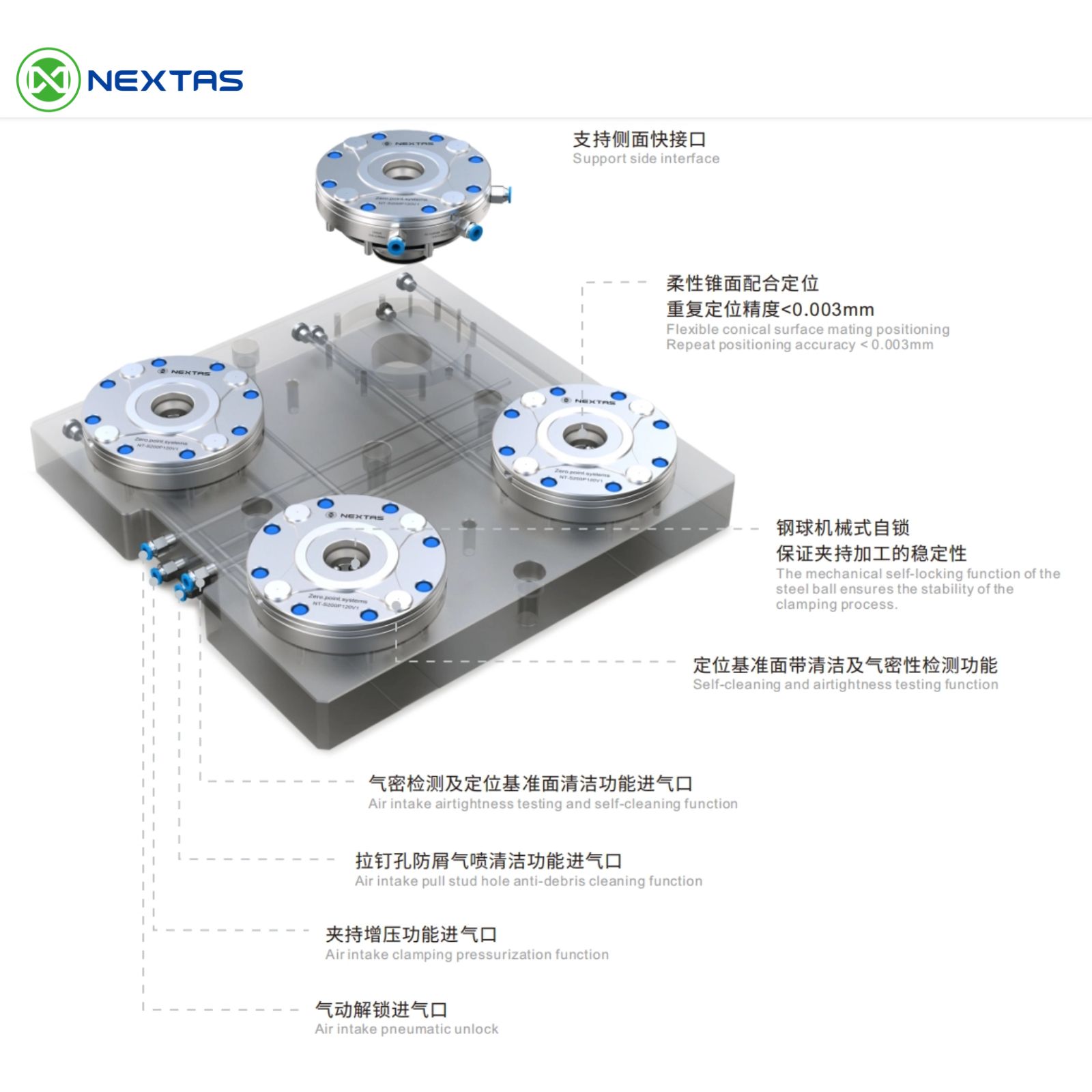
In 2026, machine uptime is the new margin. If your changeovers still depend on manually indicating parts back to center, you’re paying for spindle time that produces no chips. A zero-point clamping system turns setup into a repeatable, measurable, and automatable workflow — enabling offline fixture prep, rapid pallet swaps, and consistent re-clamping after inspection, CMM measurement, or EDM/WEDM operations.
But “zero-point” doesn’t automatically mean “zero risk.” When you’re building a palletized workholding strategy for 3-axis, 4-axis, or 5-axis machining — especially in robotic or unmanned Flexible Manufacturing Systems (FMS) — you must choose a system that can hold position, pull down hard, and verify it’s seated correctly without human intervention.
Selection checklist (fast scan)
- Repeatability: Can you remove, measure, and re-clamp without losing your datum? (Target: <0.003mm for milling.)
- Pull-down clamping force: Can it resist vibration, chatter, and multi-axis roughing without micro-lift?
- Accuracy verification: Do you have airtightness/seat-check functions for lights-out automation?
- Chip/coolant protection: Is the interface sealed and self-cleaning?
- Spigot strategy: Does your pallet avoid over-positioning (binding) with a correct stud configuration?
1) Repeatability: the foundation of precision machining
Repeat positioning accuracy (repeatability) is the baseline requirement for a zero-point system. It defines whether a pallet can move between processes (CNC ↔ CMM ↔ EDM) and return to the same zero reference while staying inside your GD&T and tolerance stack.
Taper-type flexible positioning: stability over long production runs
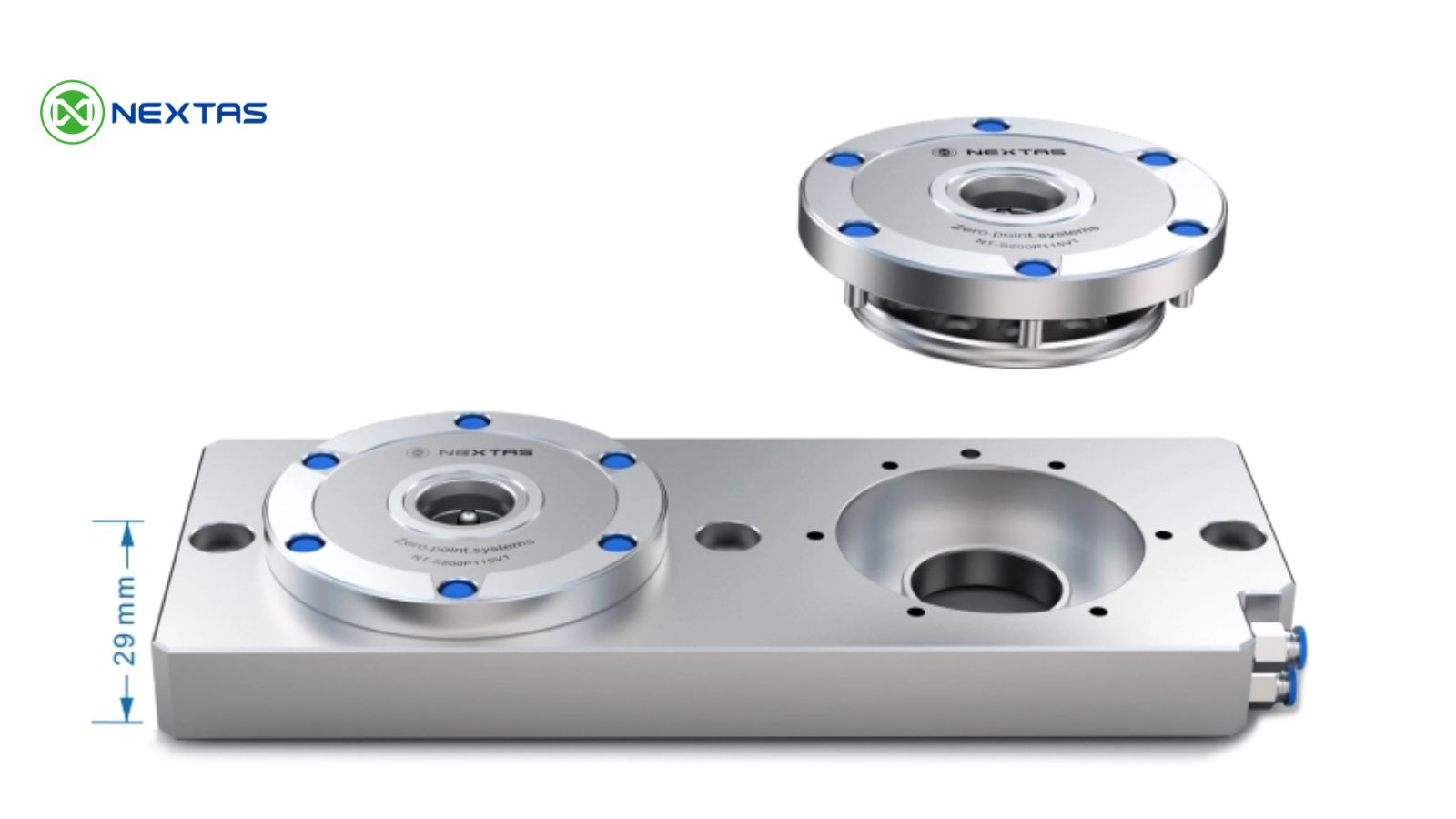
Flat datum interfaces can wear and “float” microscopically over time. Advanced systems reduce that risk with a taper-type flexible positioning structure that naturally centers the pull stud as it enters the chuck. The taper helps eliminate micro-gaps and supports long-term stability — especially important for high-mix production and frequent pallet cycling.
Target thresholds: what “good” repeatability looks like
- General heavy-duty milling: aim for <0.003mm repeatability.
- Multi-station pallets: verify system-wide repeatability remains within <0.005mm across 2/4/6-chuck combinations.
- Ultra-precision automation: for tight-tolerance cells, specify architectures built for <3μm repeat positioning.
Shop-floor reality check: Don’t accept a catalog value alone. Ask for the test method (cycle count, load state, reference tooling, and measurement approach). Then reproduce a simplified verification in your shop — see Section 6.
2) Pull-down clamping force & heavy-duty load capacity
Repeatability tells you the pallet returns to the right location. Pull-down clamping force tells you whether it stays there during aggressive roughing, high feed milling, and simultaneous 5-axis motion. If pull-down force is weak, you may see micro-lift, chatter, tool breakage, or sudden tolerance drift — even when positioning repeatability looks “perfect” on paper.
Mechanical self-locking: fail-safe by design
The most solid systems use pneumatic unlocking + mechanical locking. In a Nextas-style design, clamping force is generated by a spring + steel ball self-locking structure. This means you can cut off shop air during machining and still maintain stable clamping force.
Why it matters for FMS: In lights-out environments, a sudden air pressure drop should not release a 200–800 kg pallet. Mechanical self-locking keeps the pallet secured until intentional pneumatic release.
Clamping pressurization (boost intake) for extreme cutting
For heavy-duty operations, some chucks provide a clamping pressurization function. By introducing air into a dedicated boost port during machining, pneumatic pressure works together with the mechanical spring force — increasing total downward tension and improving resistance to vibration.
Zero-point chuck technical specification comparison (2026)
Below is a practical sizing comparison (typical values) you can use as a starting point for selecting chuck capacity for pallet weight, cutting load, and machine size.
| Model Series | Repeatability | Clamping Force | Lifting Load (Capacity) | Material | Ideal Application |
|---|---|---|---|---|---|
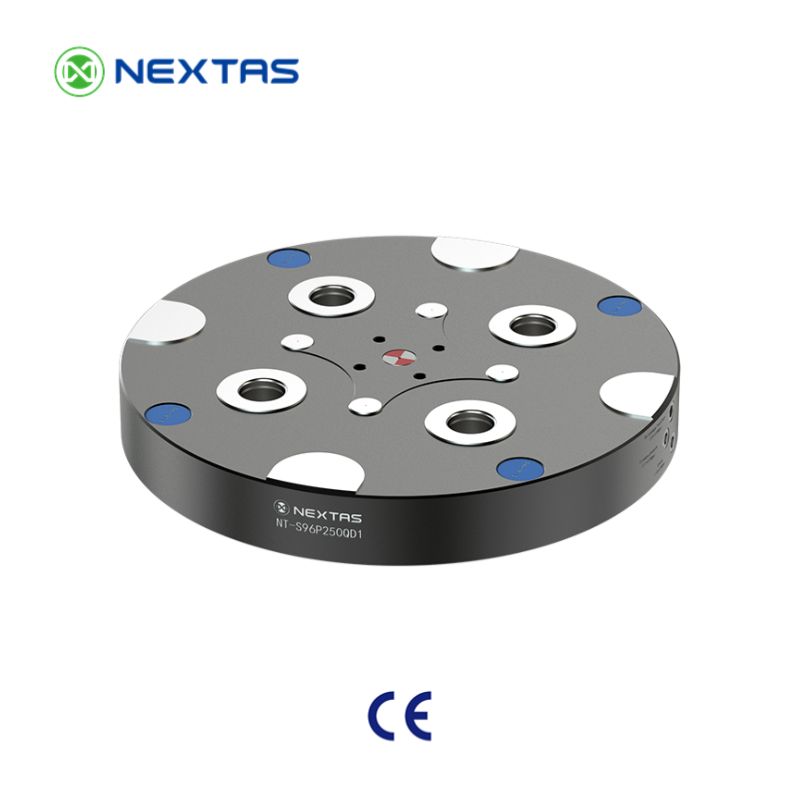
| P85 (NT-S200P85V1) | <0.003mm | 4,000 N | 30 Kg | Hardened Stainless Steel | Compact 5-axis workholding, small electrodes |
| P120 (NT-S200P120V1) | <0.003mm | 12,000 N | 100 Kg | Hardened Stainless Steel | Standard CNC milling, general fixture pallets |
| P195 (NT-S200P195V1) | <0.003mm | 40,000 N | 300 Kg | Hardened Stainless Steel | Massive workpieces, heavy roughing |
| BDS Series | <3μm | 60 KN (60,000 N) | 100 Kg (Max load 800Kg) | Hardened Stainless Steel | Ultra-precision FMS, 4×90° fixed indexing |
Note: Hardened stainless steel construction is widely preferred for durability and suitability for harsh environments including EDM/WEDM and coolant-heavy milling.
3) How to verify accuracy in unmanned automation
When operators aren’t present to indicate every pallet, your zero-point system must confirm it is seated correctly. This is where built-in accuracy verification becomes a requirement (not a luxury).
A) Airtightness testing (seat-check) for chip-sensitive datums
An airtightness testing function routes air through a dedicated sensor port after clamping. If the pallet sits perfectly flush on the Z datum, the circuit seals. If chips or debris create a micro-gap, air leaks and a connected NPN/PNP sensor can trigger a machine stop — preventing scrapped parts and protecting your spindle.
B) Self-cleaning air-jet & anti-chip protection
Coolant and chips are the enemies of repeatability. Look for integrated air-jet cleaning that blasts the Z-datum and spigot interface during unlocking, plus solid sealing (e.g., O-rings) to prevent cutting fluid and debris from entering the mechanism.
C) Unclamp lift function for heavy pallets
Heavy pallets can impact the datum surface during loading/unloading. A controlled lifting load mechanism helps gently lift the pallet off the Z reference during pneumatic unlocking — protecting the datum plane from microscopic dings and preserving long-term accuracy.
4) Avoid over-positioning: intelligent spigot configuration
A world-class chuck is only half the system. The pull studs / spigots on your pallet determine whether the setup is kinematically correct or prone to binding. Installing multiple rigid centering studs can create geometric conflict (known as over-positioning) when temperature changes or machining tolerances stack up.
To prevent jamming, Nextas-style engineering uses three functional spigot types:
- Positioning spigot: zero clearance; locks X and Y as the true zero reference.
- Compensating spigot: directional clearance; restricts rotation and absorbs thermal expansion.
- Clamping spigot: radial clearance; engages locking and increases pull-down force without restricting X/Y.
Best-practice (4-chuck pallet): 1 positioning + 1 compensating + 2 clamping spigots. This fully constrains the pallet while eliminating over-positioning risk.
5) System integration & 2026 FMS trends
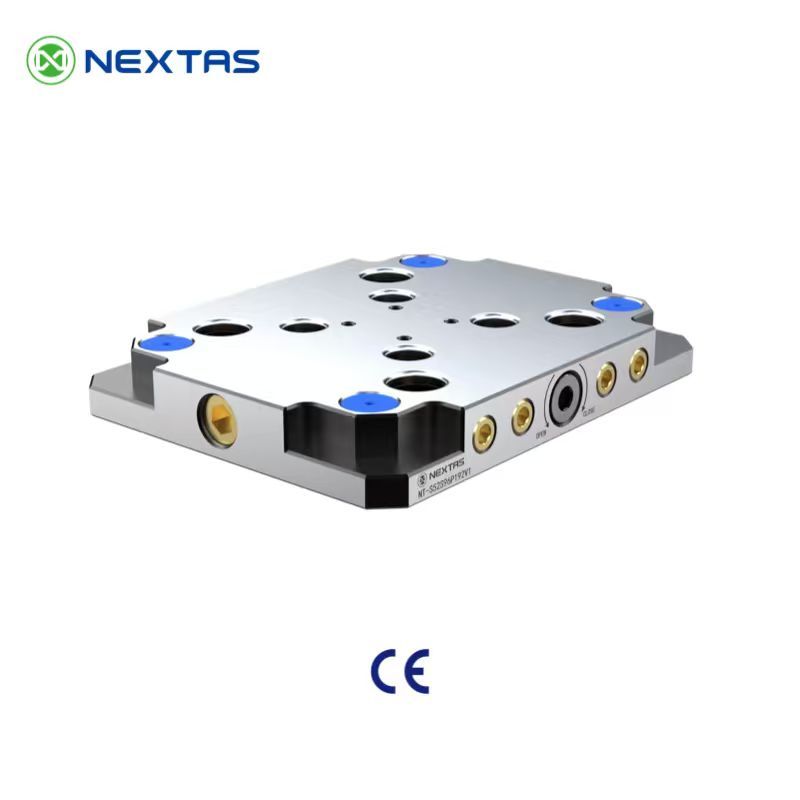
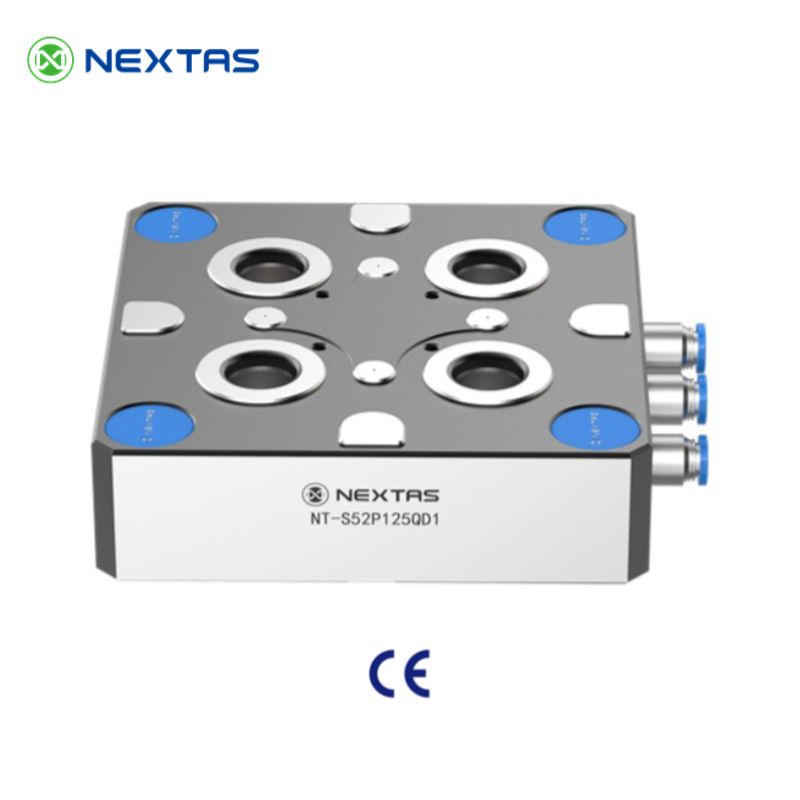
As Industry 4.0 accelerates, a zero-point system should be easy to integrate and scale. Modular designs with 52mm and 96mm industry-standard hole spacing simplify retrofits and expansion — especially if you need compatibility with existing self-centering vises and pallets.
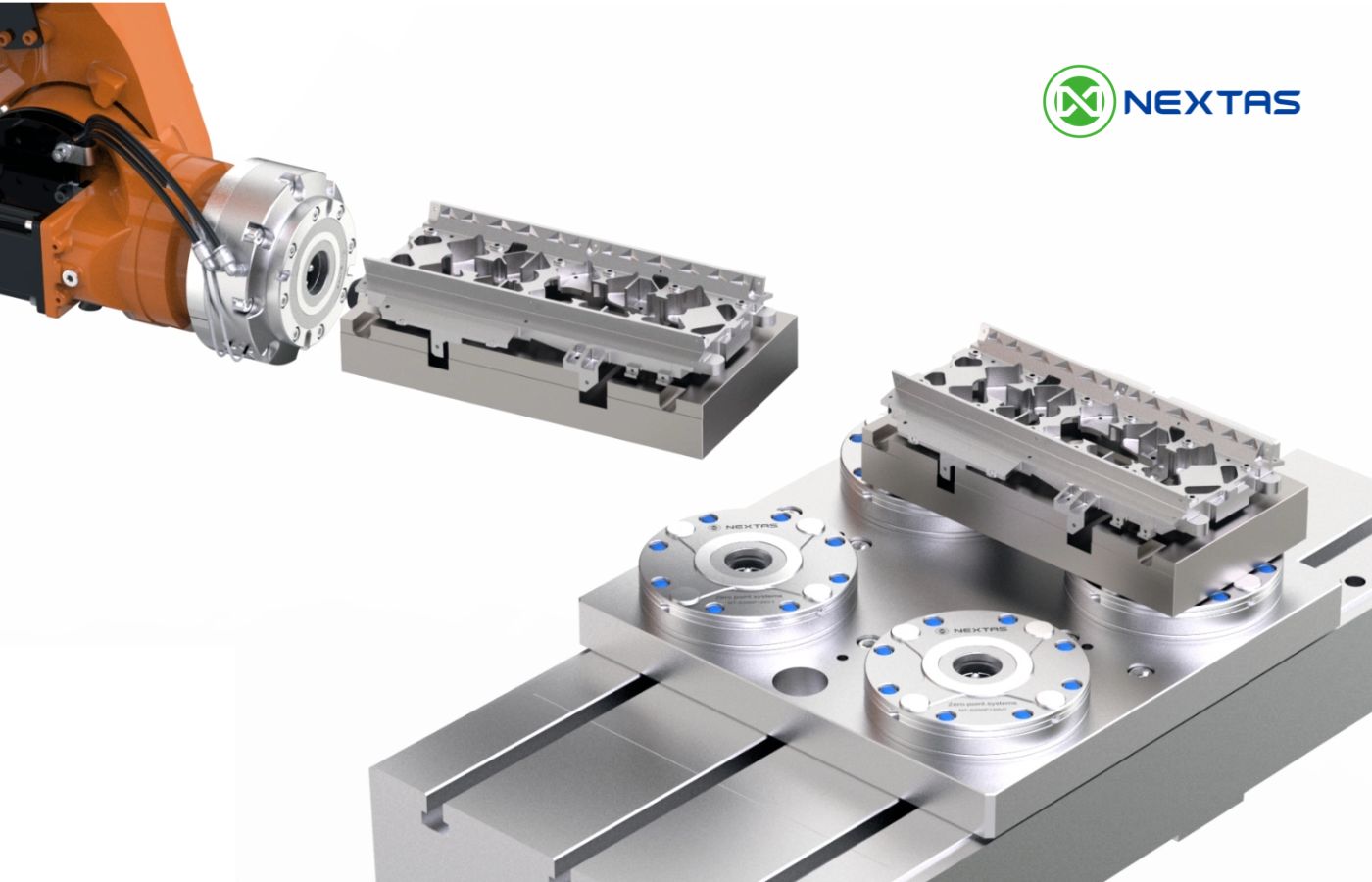
In 2026, the most common FMS pattern combines:
- A quick-change datum plate
- A 6-axis robot (e.g., KUKA, FANUC, Mitsubishi)
- A pallet pool / truss / rotary storage system for 24/7 scheduling
- Optional MES/ERP connectivity for real-time production data
6) Verification checklist: repeatability & seating accuracy
If you want predictable results, validate the system under real conditions. Here is a practical workflow many machining teams use during commissioning and PPAP-style process qualification.
Repeatability cycle test
- Prepare a test pallet with a hardened reference artifact (e.g., gauge pin or ground block).
- Clamp, probe/indicate, and record X/Y/Z reference values.
- Unclamp and re-clamp for 20–30 cycles (more if your process is high frequency).
- Calculate max deviation and standard deviation; compare against your tolerance budget.
Seat-check validation (chips & coolant)
- Introduce controlled contamination (fine chips, light coolant film) and repeat clamp cycles.
- Confirm the airtightness sensor (or seat verification logic) reliably detects non-flush seating.
- Verify your CNC/PLC interlock stops the program safely when a leak is detected.
Pull-down force confidence check
- Run a roughing program that historically causes chatter or part movement.
- Inspect witness marks, chatter patterns, and post-process measurement drift.
- If available, test boost pressurization and compare surface finish and tool life.
Conclusion & next steps
Investing in a high-precision zero-point clamping system is one of the fastest ways to remove setup bottlenecks and stabilize automation. Prioritize <0.003mm repeatability, mechanical self-locking pull-down stability, and built-in seat verification if you’re running pallets through robots and FMS cells.
Want a recommendation for your machine & pallet size?
Share your machine type (3-axis / 5-axis / EDM), pallet weight, and tolerance target. Our engineers will propose a datum chuck + spigot architecture and verification strategy that fits your cell.
- Company: Nextas
- WhatsApp: +86 13415429444
- Email: sandy@nextas.com
- Website: https://www.nextastech.com/